VEVOR split or all-in-one, which diesel heater for your van
Both are budget VEVOR heaters with an 8 kW label, and both sit in the $ band. One bolts under the floor with its own 10 L tank, the other is a box that stands outside and pushes warm air in through a duct.
The split for a van you live in, the box for a van you can’t drill
If you sleep in the van most nights and can cut two holes in the floor, take the VEVOR 8KW split heater. It mounts inside, breathes and exhausts under the floor, and VEVOR says its 10 L tank lasts up to 16 hours.
For most other vans, the VEVOR all-in-one is our top pick, from a leased or unconverted van to a trailer you heat on weekends. Nothing gets drilled, but the box has to stand outdoors and only its warm-air duct enters the van.
Both made our shortlist of the best diesel heater for a van, the box as our top pick and the split as the budget install pick. The split meets the OBAKL 2KW, the box faces the HCALORY TB MAX2.
VEVOR split and VEVOR all-in-one side by side
All numbers are from the two listings, with VEVOR’s claims marked. The box lists its weight twice with two different values, so the table shows both.
| Feature | VEVOR 8KW split with Bluetooth | VEVOR 8KW All in One (CY-32) |
|---|---|---|
| Type | Split kit, heater mounted in the van | All-in-one box, heater, tank and controls in one case |
| Heat output | 8 kW rated by VEVOR, 215 to 269 sq ft | 8 kW rated by VEVOR, 161 to 215 sq ft |
| Fuel use | 0.16–0.62 L/h (maker) | 0.18–0.36 L/h (maker) |
| Tank | Separate 10 L (2.6 gal), up to 16 hours (maker) | Built-in 5 L (1.3 gal) with fuel gauge |
| Power supply | 12 V | DC 12 to 24 V, about 3 A |
| Altitude | Automatic compensation up to 18,045 ft | Below 9,843 ft only; no auto mode listed |
| Controls | Bluetooth app up to 98 ft, 32 ft remote, LCD, voice prompts, 46 to 96.8 °F | 98 ft remote, LCD, 32 to 104 °F |
| Install needed | Floor holes for exhaust and intake, fuel line, 12 V wiring | No drilling; box outside, duct into the van |
| Weight | 15.84 lb | 7.84 lb in the spec table, 18.2 lb in another field |
| Price band | $ | $ |
| Warranty | Not stated on the listing | Not listed in what we read |
Heat output and van size
Both carry an 8 kW label, but the fuel figures tell another story. Diesel holds roughly 10 kWh per liter, so by plain arithmetic the split’s top rate of 0.62 L/h is about 6 kW of fuel energy, and the box’s 0.36 L/h is nearer 3.6 kW.
VEVOR rates the split for 215 to 269 sq ft and the box for 161 to 215 sq ft. A campervan floor is far smaller than either, and a common rule of thumb says a well-insulated van needs about 2 kW.
So the split will idle near its lowest setting most nights, which invites carbon. The box is less oversized on paper, though some owners found it could not warm a small shed. Our guide to sizing a van heater runs the numbers for your build.
Round goes to the split, for more heat in reserve on bitter nights.
Install and where the exhaust goes
The split goes in like any parking heater. It sits on a flat floor plate with a gasket, the exhaust and combustion-air pipes run below the floor, and the exhaust points away from the doors and away from its own intake.
Owners say the kit has everything you need, yet the manual is poor. Keep the hot exhaust clear of fuel lines, brake lines, wiring and plastics, and work through our through-the-floor install guide before the first cut.
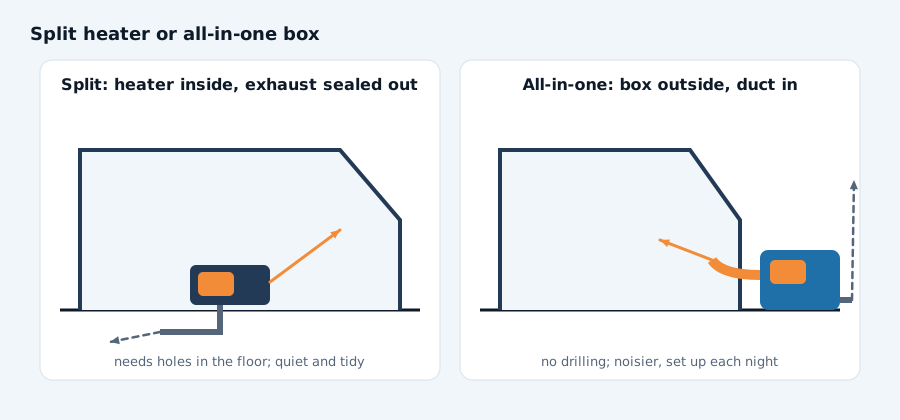
The box needs no tools at all. It stands outside on level ground, its exhaust stays outside, and the warm-air duct enters through a window gap or a port. You set it up each evening and stow it before you drive.
That convenience carries a trap. The box still burns diesel and makes exhaust, so it must never run inside the van, and snow drifting around it can block the outlet. Our carbon monoxide guide shows where fumes find their way in.
Round goes to the all-in-one if drilling is off the table, to the split if you want it fitted once and forgotten.
Fuel, tanks and 12 V power
VEVOR quotes about a gallon a night for each. The split’s 10 L tank holds about 2.6 gal, while the box’s 5 L (1.3 gal) tank means a refill most mornings in hard cold, done outside with the heater off.
The split can later move to a standpipe in the van’s own tank, so you stop carrying jerry cans. Our page on feeding the heater from the van’s tank explains why a standpipe stops short of the tank bottom.
The split runs on 12 V, and the box takes 12 to 24 V at about 3 A. Both draw far more while igniting and during the shut-down purge, so a tired battery is the usual reason either one refuses to start.
Round goes to the split, for the bigger tank and the van-tank option.
Cold starts and altitude
The split trims its fuel for thin air up to 18,045 ft, which covers any road pass you can drive. The box carries a 9,843 ft ceiling, and its listing names no automatic altitude mode.
Above its range, a heater set for sea level runs rich, smokes and cokes up. If you chase snow at ski areas, our guide to running a heater up high explains what to watch for.
The box lights with a ceramic igniter that VEVOR pitches for cold starts. With both, switch to winter diesel once frost arrives, because summer fuel can gel, and never pour gasoline into either tank.
Round goes to the split, on altitude.
Noise and controls
Mounted inside, the split lets you hear its fan and the tick of the dosing pump, though a rubber-mounted pump and the silencer under the floor help. The box stands outside, which moves the pump noise out of the cabin.
Controls favor the split, with a Bluetooth app, a 32 ft remote, an LCD with voice prompts, a thermostat mode and a timer. The box offers a 98 ft remote and an LCD. Split owners report a thermostat that can read off, and box owners mention error codes and shutdowns.
Round goes to the split on controls, to the box on noise in the cabin.
Price band and value
Both sit in the $ band, under $150, so price rarely settles it. The split asks for an afternoon of careful work, while the box asks for a few minutes of setup every night and a plan for rain and snow.
Plenty of owners run budget VEVORs happily for a winter or two, and a failing fuel pump is the split’s most common complaint. Neither listing states a warranty term, so check before you order.
Round goes to neither, a draw on price.
The split’s catch is the hole in your floor, a poor manual and a pump that owners say can quit, so a spare pump is cheap insurance on a long trip. The box’s catch is its exhaust, which belongs outside every time, plus a small tank and nightly setup.
Live in it, or visit it
If the van is your home through the winter, fit the split, since a sealed exhaust under the floor and a bigger tank suit nightly use. For most other vans, choose the all-in-one, our top pick, then leave the box outside and keep a CO alarm by the bed.