VEVOR all-in-one, the van heater we would pick
The VEVOR all-in-one is our top pick for most vans. It packs heater, tank and controls into one case, so you get diesel heat without cutting a hole in your van, in the lowest price band of our lineup. We did not run one ourselves, so this review weighs the listing against what owners report, catches included.
 Our top pick
Our verdict
The VEVOR all-in-one is our top pick because most van owners can buy it, use it without drilling and take it along to the next van. It runs on 12 or 24 V, sips fuel and warms a trailer in cold weather, per owners. Every night the box has to sit outside and feed warm air in through its duct, unless its exhaust is sealed and piped out, and it is noisier than a fitted heater. Owners report error codes and shutdowns, and it is rated only below 9,843 ft with no altitude mode stated.
Strengths
- No drilling, heater and 5 L tank in one case
- Runs on 12 or 24 V DC, about 3 A per the listing
- Low fuel use, 0.18 to 0.36 L/h per VEVOR
- Ceramic igniter, fuel gauge and leak-proof cap
- Plenty of owner reviews, and it moves between van, tent and workshop
Weaknesses
- Box must sit outside or have its exhaust piped out
- 8 kW label is far above its fuel rate
- Error codes and shutdowns in owner reports
- Rated only below 9,843 ft, no altitude mode stated
- Setup each night, and noisier than a fitted heater
Buy it if
you rent, lease or simply will not drill your van, and you will set the box up outside with only its warm-air duct coming in.
Skip it if
you want permanent heat for full-time van life, camp above 9,843 ft, or would be tempted to bring the box inside on a cold night.
Specs: VEVOR 8KW All in One diesel heater
| Type | All-in-one box: heater, 5 L (1.3 gal) tank and controls in one case |
|---|---|
| Heat output | 8 kW rated by VEVOR |
| Rated area | 161 to 215 sq ft |
| Fuel use | 0.18 to 0.36 L/h (maker) |
| Power | DC 12 to 24 V, about 3 A (listing) |
| Ignition | Ceramic igniter |
| Controls | 98 ft remote, LCD; 32 to 104 °F |
| Altitude | For use below 9,843 ft; no automatic altitude mode stated |
| Safety | Heat-shielded exhaust pipe, leak-proof fuel cap, fuel gauge |
| Size | 16.34 × 7.09 × 16.14 in |
| Weight | 7.84 lb in the spec table; another listing field says 18.2 lb |
| Placement | Box outside the van or exhaust piped outside; only the warm-air duct comes in |
Data from the Amazon.com listing and, where marked, from the maker. Price band $: under $150. Only the price Amazon shows at checkout counts.
Why it is our top pick for most vans
Most people shopping for a van heater are not ready to cut holes in the floor. The van may be leased, rented or still an empty shell, and this box gives them diesel heat without touching any of it.
It is also the cheapest heater in our five and carries far more owner feedback than the rest. That record matters on a budget heater, because it shows what goes wrong as well as what works.
We weighed it against the better-built Espar and still chose the box for most readers. The trade is a nightly setup outside the van and a few plain limits, and every one of them is spelled out below.
Heat output, and why 8 kW is a stretch
VEVOR rates the CY-32 at 8 kW for 161 to 215 sq ft. The fuel figures on the listing say something different.
At its top rate of 0.36 L/h, with roughly 10 kWh of energy per liter of diesel, about 3.6 kW of fuel goes in. By that arithmetic the label is more than twice the fuel energy, and the heat reaching your van is lower still.
That still covers a small van. Rule-of-thumb sizing gives a well-insulated campervan about 2 kW, and owners report it warms a trailer in cold weather, though some found it could not heat a small shed.
No drilling, but the box stays outside
The appeal is in the name. Heater, 5 L (1.3 gal) tank and controls share one case, so there is no floor plate to cut, no pump to mount and no fuel line to run.
The catch is that the box still burns diesel and produces exhaust. It belongs outside, sending heat in through the warm-air duct, unless its exhaust is sealed and piped out of the van.
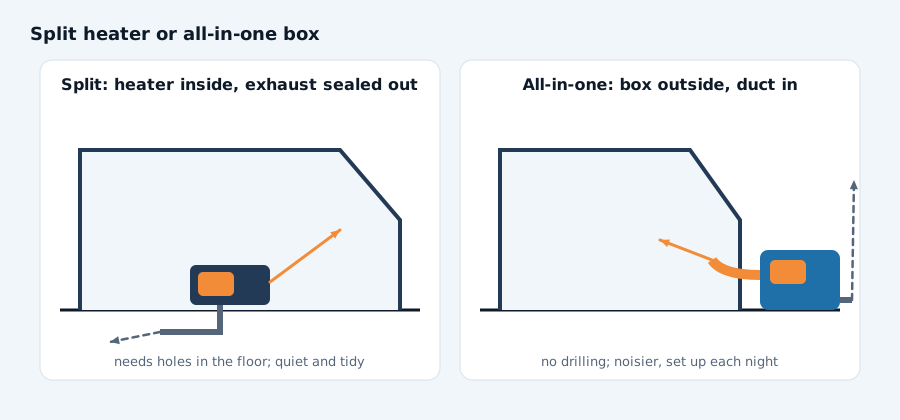
Outside, it needs a level spot with the exhaust pointing away from the van’s doors, windows and the duct inlet. Our VEVOR split or all-in-one page weighs that nightly routine against a permanent install.
The listing gives 16.34 × 7.09 × 16.14 in, and its weight fields disagree, 7.84 lb in one place and 18.2 lb in another. Plan on something between about 8 and 18 lb.
Fuel and power on 12 or 24 V
VEVOR lists 0.18 to 0.36 L/h, “1 gallon per night”, and claims at least 90% combustion efficiency. By our arithmetic the 5 L tank lasts roughly 14 hours on high and close to 28 hours on low.
The listing gives 12 to 24 V DC at 3 A. If that is the running draw, it means about 36 W at 12 V, or near 24 Ah over an eight-hour night, plus the igniter’s pull at each start. Run it from a house battery, never the starter battery.
Our guide to battery use overnight shows how to size a bank for that load, and why a weak battery causes most failed starts.
Altitude and cold starts
The listing says it works below 9,843 ft, and no automatic altitude mode is stated. Thin air already pushes a sea-level heater toward rich running, so watch for smoke and soot as you climb toward that limit.
Our guide to diesel heaters at altitude covers the symptoms. A ceramic igniter handles cold starts, and winter-grade diesel matters more here than in a split heater, because the fuel sits in a tank exposed to the night air.
Controls and noise
A 98 ft remote and an LCD on the box run it, with a set range of 32 to 104 °F and a fuel gauge on the tank. Owners mention error codes and shutdowns, so learn the codes from the manual before a cold night.
Outside placement helps with noise. The fan and the ticking pump stay outside the van, and only moving air comes through the duct.
Keep the warm-air duct short and insulated where it crosses the gap to the van. A long, bare duct loses heat to the night air before it reaches you, and a door or window cracked for the duct needs sealing around it so the draft does not undo the heat.
Seal that gap carefully for a second reason. An opening near the box is also an opening near its exhaust, so point the outlet the other way and keep the two well apart.
Safety and the exhaust
An all-in-one is the easiest diesel heater to use wrongly. Run inside a closed van with its exhaust in the cabin, it can kill you in your sleep, and that is the one rule this review will not soften.
Keep the box outside, or seal the exhaust and pipe it outside, and point the outlet away from every opening. Brush snow off the exhaust, never refuel while it runs, and never sleep with the box inside the van.
The heat-shielded exhaust pipe and leak-proof cap help, but they are no protection against CO. Hang a separate battery CO alarm by the bed and read our guide to carbon monoxide in a van before the first night.
What owners report
Many owners say it works as advertised and warms a trailer in cold weather. For a few cold weekends a year, that is the job most buyers want done.
The complaints center on error codes and shutdowns, and some found it could not heat a small shed. Clean fuel, a charged battery and the occasional run on high help keep a budget box like this one lighting.
Outside placement brings its own chores. The box has to be carried out, leveled and connected each evening, then packed away wet or frosted in the morning.
The listing gives no rain or splash rating that we could find, so shelter the box from driving rain and snow without boxing in the exhaust. Lock it to the van if you park somewhere busy, since a portable heater is easy to lift.
Against the VEVOR split, the HCALORY and the Espar
The VEVOR 8KW split sits in the same $ band but mounts inside with its exhaust through the floor. It adds automatic altitude compensation and saves the nightly setup, at the cost of drilling.
The HCALORY TB MAX2 is a bigger box with a 7.9 L tank that also runs on 110 V, in the $$ band on a young listing. The Espar Airtronic D2L is our premium pick for a permanent build, quieter and better built at several times the price.
See the all-in-one’s homepage card or the whole lineup in our diesel heater comparison for vans.
Our top pick for most vans
If you want diesel heat this winter without touching the floor of your van, this box is our pick, and it costs little. Set it up outside every night with only the duct coming in, and keep a CO alarm by your bed.