Feeding a diesel heater from the van’s tank or its own
Every diesel heater needs a fuel source, and you have two choices. A standpipe in the van’s own tank means you never refill the heater, and a separate tank means you never touch the van’s fuel system. This guide weighs the two and shows how much diesel a night takes.
Two ways to feed the heater
A split heater draws diesel through a thin fuel line and a dosing pump. That line can start at a standpipe in the van’s main tank, or at a small separate tank mounted somewhere in or under the van.
An all-in-one box settles the question for you, since its tank is built in. The VEVOR all-in-one holds 5 L (1.3 gal) and the HCALORY TB MAX2 holds 7.9 L.
A separate tank
Most budget split kits come with their own tank. The VEVOR 8KW split includes a 10 L (2.6 gal) tank, and the OBAKL 2KW comes with a 5 L tank, though its listing says the pickup may also draw on the van’s own tank in reserve.
The big advantage is that the van’s fuel system stays untouched. There is no work on the main tank, and an install mistake on the heater side cannot leave the van short of fuel.
The cost is refilling. You carry a fuel can or top the tank up at the pump, and the tank needs a safe, vented home where a spill cannot reach the cabin.
A standpipe in the van’s tank
A standpipe is a pickup tube fitted into the vehicle’s tank, usually through the sender unit or a dedicated port. The heater then draws from the same diesel the engine burns.
The standpipe does not reach the bottom of the tank, so the heater stops drawing before the tank runs dry. The engine keeps a reserve and you are never stranded by a night of heat.
It is the tidier install, but it means opening the van’s fuel system. The Espar listing allows a standpipe, or an auxiliary tap where the vehicle maker offers one, but its kit list names neither, nor a fuel filter.
Many owners hand the standpipe to a shop, since it means opening the tank and its sender. If you fit it yourself, work with the tank as empty as practical and keep dirt out of the opening.
The two routes side by side
| Separate tank | Standpipe in the van’s tank | |
|---|---|---|
| Install work | Mount the tank, run a short line | Open the vehicle tank, fit the pickup |
| Van’s fuel system | Untouched | Modified |
| Refilling | By hand, every few nights | Every time you fill the van |
| Range | Limited by the tank size | As long as the van tank lasts |
| Risk of running the van dry | None | None, the standpipe stops short |
| Parts | In most budget kits | Vehicle-specific kit, often bought separately |
How much diesel a night takes
The makers list fuel use per hour, and the chart shows the low and high rates. On any of these heaters, a night spent mostly on low burns well under a gallon.
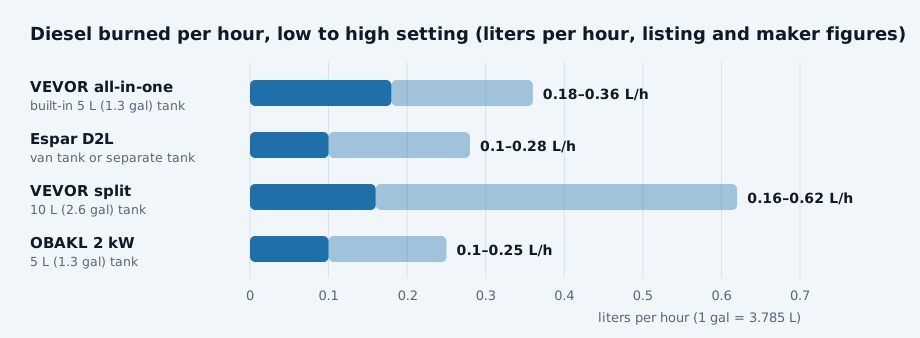
- Espar Airtronic D2L: about 0.10 to 0.28 L/h, from Eberspächer’s published D2 figures rather than the listing
- VEVOR 8KW split: 0.16 to 0.62 L/h, which VEVOR puts at about 1 gallon per night and up to 16 hours per 10 L tank
- VEVOR all-in-one: 0.18 to 0.36 L/h (maker)
- OBAKL 2KW: 0.1 to 0.25 L/h, so roughly 20 to 50 hours from its 5 L tank
- HCALORY TB MAX2: 0.12 L/h on minimum and up to 65 hours per tank (maker); the maximum is not listed
Simple arithmetic puts ten hours at 0.2 L/h at 2 L, a little over half a gallon.
Fuel use climbs on the high setting. At 0.62 L/h, the VEVOR split’s top rate, the same ten hours would take 6.2 L, about 1.6 gallons, though a warm van seldom runs flat out all night. A heater sized to your van idles less and burns less, which our sizing guide explains.
Where the pump and line go
Mount the dosing pump close to the fuel source, angled upward at usually 15 to 35°, and on rubber so its ticking stays quiet. A long uphill run from tank to pump invites air bubbles and stalls.
If your kit has no fuel filter, fit one between the fuel source and the pump. Dirt from an old tank is the last thing a pump that meters fuel by the drop needs.
Keep the line short, clipped and well away from the exhaust. Our step-by-step installation guide puts the pump and line into the full layout.
Winter diesel and other fuel trouble
Summer diesel can gel in hard frost, and a thin heater line gels before the van’s main lines. Switch to winter-grade diesel, or whatever winter blend local pumps sell, before the cold arrives, in the van and in a separate tank alike.
Never run a diesel heater on gasoline. If a separate tank sits beside other fuel cans, label it so nobody tops it up from the wrong one.
Gelled fuel, air in the line and a blocked filter all show up as a heater that will not light. Our guide to a diesel heater that won’t start works through them in order.
Altitude changes the burn, not the fuel. Thin mountain air makes any heater tuned for the coast burn rich, whichever tank feeds it, as our high-altitude guide explains.
Which route suits you
- Separate tank: budget kits, rented or leased vans, and anyone who wants the van’s fuel system left alone
- Standpipe: a van you own and live in all winter, where refilling a small tank every few nights gets old
- Built-in tank: an all-in-one box used now and then, standing outside the van
If price drives the choice, our look at a cheap diesel heater under $150 covers what the budget kits and their tanks give up. For the whole lineup, see our van heater picks, the heater cards and the fuel figures under how it works.
For a van you would rather not plumb into
The VEVOR 8KW split ships with its own 10 L tank, so the van’s fuel system stays as it is, and VEVOR rates it at 0.16 to 0.62 L/h. Owners report fuel-pump failures on some units, so carry a spare plan for a cold night.