VEVOR 8KW diesel heater, the budget install
The VEVOR 8KW split heater is how many van builders get diesel heat for a small slice of the Espar’s price. It comes with a tank, a remote and an app, and it heats fast. We did not fit one, so this review sets VEVOR’s claims against the arithmetic and what owners report.
 Budget install pick
Our verdict
The VEVOR 8KW is the cheapest sensible way to put a permanent diesel heater in a van. It heats fast, holds a set temperature in freezing weather and adds altitude compensation that older budget kits lacked. The 8 kW label overstates it, the size is too big for a small van, and owners report fuel pumps that fail and thermostats that read off. Fit it carefully, keep a CO alarm by the bed and treat it as a heater for a few winters, not a decade.
Strengths
- $ band price with a 10 L (2.6 gal) tank included
- Automatic altitude compensation up to 18,045 ft
- Bluetooth app, remote and LCD controller
- Heats a trailer quickly, holds a set temperature in the cold
- Separate tank leaves the van’s own tank untouched
Weaknesses
- 8 kW label overstates it, nearer 6 kW of fuel energy
- Too big for a small van, so it runs on low and sooty
- Fuel pump can fail, per owners
- Thermostat can read off, and the manual is poor
- No warranty stated on the listing
Buy it if
you have a large van, a box truck or a cargo trailer, a small budget and the patience to do a careful through-floor install.
Skip it if
you sleep in a small, well-insulated van most of the winter and want a quiet heater that lasts many years.
Specs: VEVOR 8KW Bluetooth diesel heater
| Type | Split diesel air heater with a separate 10 L (2.6 gal) tank |
|---|---|
| Heat output | 8 kW rated by VEVOR (its top fuel rate works out nearer 6 kW of fuel energy) |
| Rated area | 215 to 269 sq ft (20 to 25 m²) |
| Fuel use | 0.16 to 0.62 L/h; up to 16 hours per tank (maker) |
| Power | 12 V |
| Controls | Bluetooth app up to 98 ft, 32 ft remote, LCD; 46 to 96.8 °F; thermostat and timer modes; voice prompts |
| Altitude | Automatic altitude compensation up to 18,045 ft |
| Safety | Overheat protection at 518 °F (270 °C) |
| In the box | Heater, 10 L tank, LCD controller, remote, silencer |
| Size and weight | 14.8 × 5.5 × 6.9 in, 15.84 lb |
| Warranty | Not stated on the listing |
Data from the Amazon.com listing and, where marked, from the maker. Price band $: under $150. Only the price Amazon shows at checkout counts.
8 kW on the label, about 6 kW of fuel
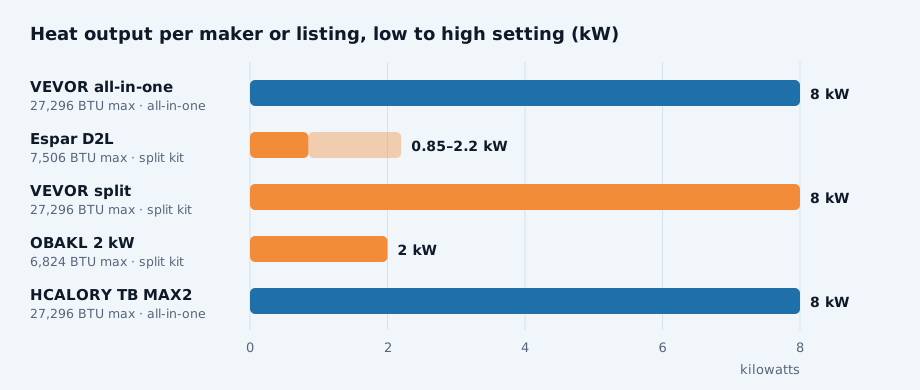
VEVOR rates this heater at 8 kW and 215 to 269 sq ft (20 to 25 m²). The fuel figures on the same listing tell a smaller story.
At roughly 10 kWh per liter of diesel, 0.62 L/h at full power means about 6 kW of fuel going in. That arithmetic makes 8 kW a marketing number, and the heat reaching the van is lower again.
Even 5 or 6 kW is a lot for a van. A well-insulated campervan is often sized at around 2 kW by rule of thumb, so this heater will sit near its minimum most nights, and long low runs encourage carbon build-up. Big, drafty vans and trailers suit it better.
The sandblasted aluminum heat exchanger is the part that keeps exhaust and cabin air apart. On a heater in this band it deserves a look each autumn, along with the exhaust joints under the van.
Installing the split kit
The heater mounts inside the van, with exhaust and intake through the floor, while the separate 10 L (2.6 gal) tank sits wherever you can reach it to refill. A separate tank keeps the van’s own fuel system untouched.
The listing names the heater, the tank, an LCD controller, a remote and a silencer. Owners say the install can be easy with everything in the box but the manual is poor, so lean on our guide to fitting a heater through the floor instead.
Fit the dosing pump near the tank and tilt it upward 15 to 35°, on a rubber mount against ticking. The listing gives 14.8 × 5.5 × 6.9 in and 15.84 lb, so plan a flat floor plate with a good gasket.
If refilling a separate tank sounds tiresome, our guide to tapping the van’s tank or using the heater’s own covers the standpipe route and its trade-offs.
Fuel and running costs
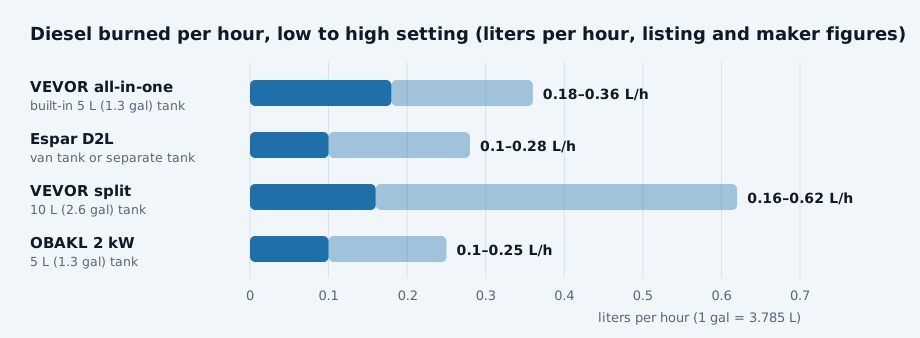
VEVOR quotes 0.16–0.62 L/h, “about 1 gallon per night”, and as much as 16 hours from the 10 L tank. Our arithmetic says 16 hours is what a full tank gives on high, and on the lowest setting it would stretch past 60 hours.
Most diesel heaters draw little current once lit, typically 1–3 A at 12 V. Starts and purges pull much more through the glow plug, which is why a tired battery is the most common cause of failed starts and low-voltage errors.
Altitude and cold starts
Automatic altitude compensation up to 18,045 ft sets this kit apart from older budget heaters. Without it, a heater tuned for sea level runs rich in the mountains, smokes and slowly chokes on carbon.
VEVOR says the space is warm within about 10 minutes, and owners report it holds a set temperature in freezing weather. Fill the tank with winter-grade diesel before hard frost, because summer fuel can gel in a thin line.
Controls, Bluetooth and noise
You can run it three ways, from a Bluetooth app up to 98 ft (30 m), a 32 ft (10 m) remote or the LCD controller. Thermostat mode, a timer and voice prompts cover a set range of 46 to 96.8 °F (8 to 36 °C).
Owners report the thermostat can read off, so the van may run warmer or cooler than the display suggests. A cheap stick-on thermometer near the bed tells you what the heater does not.
The dosing pump ticks like every budget pump. A rubber mount, a silencer on the intake and a pump placed away from the bed help, and our glossary entry on the dosing pump explains why it clicks.
Safety and the exhaust
Combustion is sealed off from the cabin and the exhaust exits below the floor, so a careful install is safe. A loose exhaust joint, an outlet under the sliding door or a cracked exchanger can put carbon monoxide in the van.
Aim the exhaust away from doors, windows and the intake, and route fuel lines and wiring well away from the hot pipe. Overheat protection cuts in at 518 °F (270 °C), but it does nothing about CO, so mount a separate battery CO alarm by the bed.
Never pull the fuse or flip a battery switch to stop it. Turn it off at the controller and wait for the purge to end, or the glow plug and burner pay the price.
What owners report
Owners say it heats a trailer quickly and keeps a set temperature through freezing nights, which is a lot to ask in the $ band. Plenty of owner reviews back that up.
The recurring complaint is the fuel pump, which can fail, along with a thermostat that reads off. The listing states no warranty, so keep the receipt and check the return terms before you start drilling.
Because it is oversized for most vans, run it on high for a while every few days to burn off carbon. Our glossary entry on error codes helps when the display starts flashing numbers.
Since the pump is the part owners most often see fail, a spare in the van is cheap insurance on a heater this inexpensive. It turns a cold, dead night into a short roadside swap.
Against the Espar, the all-in-one and the OBAKL
The Espar Airtronic D2L costs several times more but is sized at 2 kW, quieter and covered by a warranty. Our Espar or VEVOR buying guide weighs whether that gap pays off in your van.
The VEVOR all-in-one, the box we rank first, skips the drilling but has to sit outside each night. The OBAKL 2KW is a split heater sized for a van in the $$ band, on a young listing with few owner reports yet.
See the VEVOR’s homepage card or set all five side by side in our van diesel heater comparison.
For a big van on a small budget
If you heat a large van, a box truck or a trailer and the budget is tight, the VEVOR 8KW gives you fast, permanent heat for little money. Fit the exhaust with care, hang a CO alarm and expect to replace a pump one day.


