OBAKL 2KW or VEVOR 8KW heater, small or big
Both are split heaters that mount inside the van and send their exhaust under the floor. The OBAKL is a 2 kW unit sized for a campervan, the VEVOR carries an 8 kW label, a bigger tank and a Bluetooth app for less money.
The OBAKL for a small insulated van, the VEVOR for a big or drafty one
A campervan with decent insulation is where the OBAKL 2KW makes sense. At 2 kW it matches the usual rule of thumb for a van, so it can run at a steady middle setting instead of idling on its lowest step all night.
The VEVOR 8KW split fits a high-roof cargo van with thin insulation, a box truck, or a budget that will not stretch past the $ band. Both listings promise automatic altitude adjustment up to 18,045 ft, so the mountains do not split them.
Both appear in our diesel heater comparison for vans, the OBAKL as the right-sized 2 kW and the VEVOR as the budget install pick. The OBAKL also meets the Espar D2L, and the VEVOR goes up against its own all-in-one sibling.
OBAKL 2KW and VEVOR 8KW side by side
Figures come from the Amazon.com listings, with VEVOR’s own claims marked. Where a listing leaves a number out, such as a warranty term, the table says so rather than guessing.
| Feature | OBAKL 2KW (OAH-B1) | VEVOR 8KW split with Bluetooth |
|---|---|---|
| Type | Split heater, red aluminum housing | Split kit, orange housing |
| Heat output | 2 kW (about 6,800 BTU) | 8 kW (VEVOR’s rating), for 215 to 269 sq ft |
| Fuel use | 0.1 to 0.25 L/h | 0.16 to 0.62 L/h (maker) |
| Tank | 5 L (1.3 gal); standpipe can also draw from the van tank | 10 L (2.6 gal); VEVOR says up to 16 hours |
| Power supply | 12 V | 12 V |
| Altitude | “Plateau Mode”, automatic up to 18,045 ft | Automatic compensation up to 18,045 ft |
| Controls | Talking LCD switch (English or German voice), LCD remote up to 160 ft, thermostat, timer, °F/°C | App over Bluetooth (98 ft), remote (32 ft), LCD with voice prompts; 46 to 96.8 °F |
| Install needed | Exhaust and intake through the floor, a fuel line and 12 V wiring | Exhaust and intake through the floor, a fuel line and 12 V wiring |
| Weight | 13.16 lb | 15.84 lb |
| Price band | $$ | $ |
| Warranty | Not stated on the listing | Not stated on the listing |
Heat output and the size of your van
Rule-of-thumb sizing gives a snug, well-insulated campervan roughly 2 kW, and a big van with thin insulation or a bitter climate 4 to 5 kW. The OBAKL lands on the first figure, and the VEVOR sits far above both.
The VEVOR’s 8 kW is a label, though. At its top rate of 0.62 L/h it burns roughly 6 kW of fuel energy, going by about 10 kWh per liter of diesel, and less of that reaches the cabin.
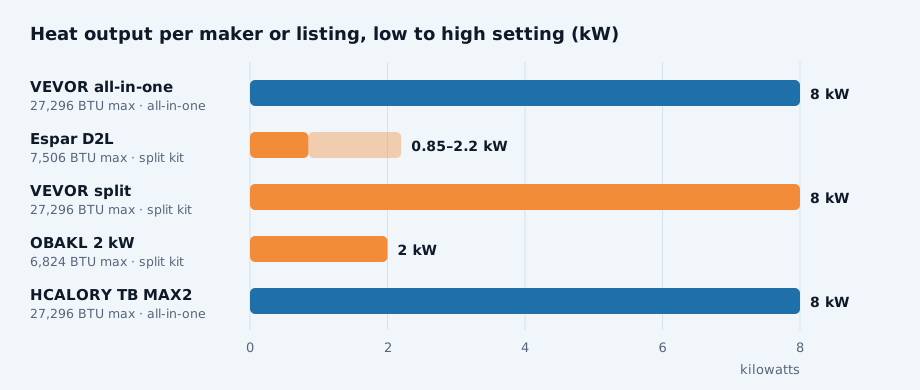
Oversizing has a cost. A heater that spends most nights on low soots up faster, which our guide to white smoke and carbon explains along with the habit of running it on high now and then. Our van sizing guide helps you pick your number.
Round goes to the OBAKL for most vans, to the VEVOR for a big cold box.
Install and tank
Both go in the same way, on a floor plate with a gasket, exhaust and intake under the floor, the exhaust aimed away from doors and from the intake. Neither box is a weekend shortcut, and both deserve the same care with the hot pipe.
The VEVOR ships with a 10 L tank, LCD, remote and silencer, and owners call the install easy once they get past a poor manual. The OBAKL comes with a 5 L tank, half the size, though its lower burn stretches that to about 20 hours on high.
Either can be moved later to a standpipe in the van’s own fuel tank. Fitted that way, tank size stops mattering at all.
Round goes to the VEVOR, for the larger tank and a well-trodden install.
Fuel use and battery draw
VEVOR quotes 0.16–0.62 L/h, roughly a gallon a night. OBAKL lists 0.1–0.25 L/h, so on high the OBAKL burns well under half the VEVOR’s top rate, while also giving out less heat.
Both run on 12 V and pull the most current while the glow plug heats and during the purge at shut-down. Our overnight battery guide shows how to size the bank, and why cutting power mid-run is a bad idea.
Round goes to the OBAKL, for less diesel per night in a small van.
Cold and altitude
OBAKL says its heater runs from −40 °F to 122 °F, and its “Plateau Mode” adjusts combustion automatically up to 18,045 ft. VEVOR gives no low-temperature limit for the split, but it promises automatic altitude compensation to the same height.
On paper the two match up high. The VEVOR has far more owner reviews overall, while the OBAKL is too new to judge. Run either on winter diesel once frost sets in.
Round is a draw, the same altitude ceiling on both listings.
Controls, noise and build
The OBAKL has a talking LCD switch in English or German, an LCD remote rated to 160 ft, a thermostat and a timer, and it reads in °F or °C. The VEVOR adds a Bluetooth app up to 98 ft on top of its remote, LCD and voice prompts.
Neither listing gives a noise figure. The dosing pump’s tick is the sound that keeps you awake, so mount it on rubber whichever you choose, as our guide to a quieter heater at night describes.
The OBAKL’s all-aluminum shell is sold as corrosion resistant, which suits a heater living under a damp van floor. VEVOR owners praise how fast it heats a trailer but some mention a fuel pump that gave out or a thermostat reading wrong.
Round goes to neither, a draw, app against aluminum.
Price band and track record
The VEVOR sits in the $ band, under $150, and the OBAKL in the $$ band. That is a real gap for a first conversion, and the VEVOR comes with a bigger tank thrown in.
Track record is the other gap. The VEVOR has plenty of owner reviews, good and bad, while the OBAKL is a young listing with few owner reports yet, so its long-run reliability is still unknown.
Round goes to the VEVOR, on price and on what owners have reported.
The OBAKL’s catch is its short record, with few owners yet to confirm its fuel figures or Plateau Mode, and no stated warranty. The VEVOR’s catch is size, since an 8 kW label in a small van means long nights on low and more carbon, plus a pump that some owners have had to replace.
Right-sized or more for less
For a well-insulated campervan, the OBAKL’s 2 kW is the better match, and the aluminum shell is a nice bonus. Choose the VEVOR if your van is big or cold, you want app control, or the budget has to stay under $150.