HCALORY TB MAX2, a diesel heater box on 110 V
The HCALORY TB MAX2 puts an 8 kW diesel heater, a 7.9 L tank and the controls in one toolbox-style case that runs on 12 V, 24 V or 110 V. We did not run one, so this review weighs the listing against general diesel heater practice, and it is frank about the exhaust.
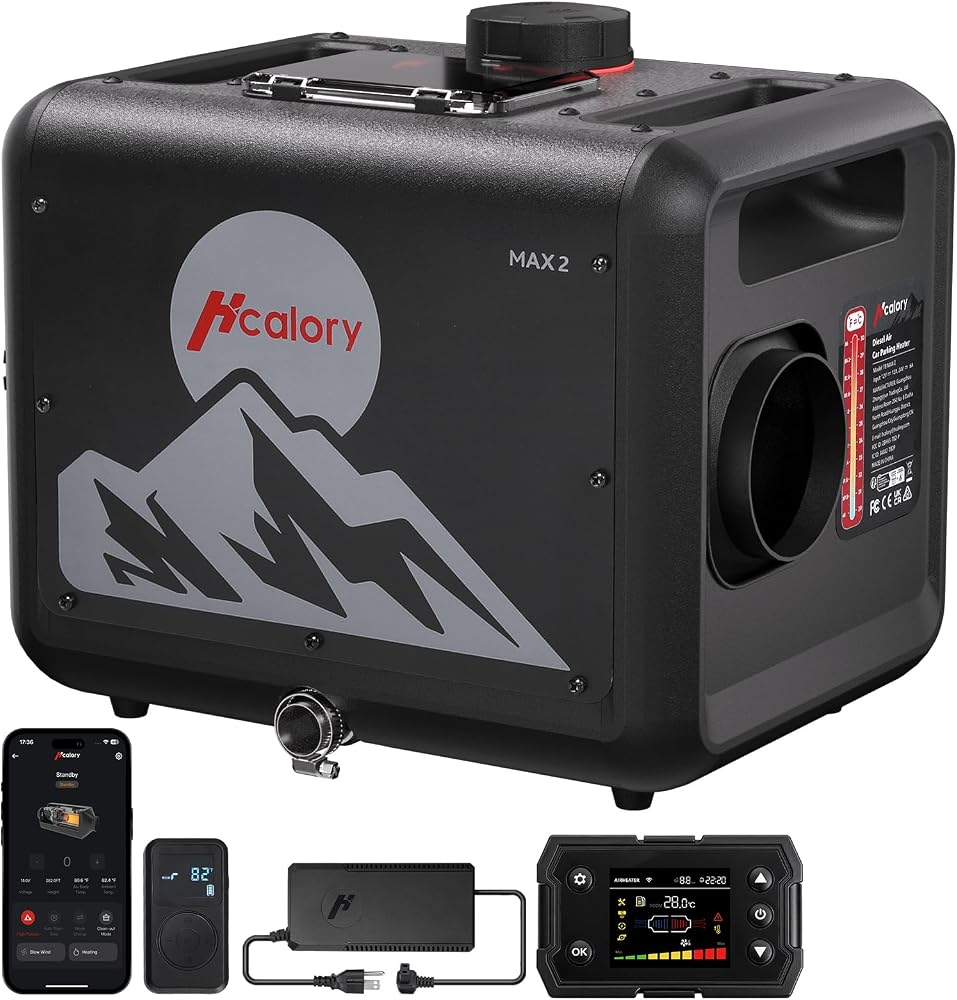 Runs on 110 V too
Our verdict
The TB MAX2 is the most complete heater box in our five, with a bigger tank, mains power, an altitude mode and a carbon self-cleaning routine. The 110 V option earns its place at campsites with hookups, where it spares your house battery. Like every all-in-one, it must stand outside the van or have its exhaust sealed and piped out, and at about 28 lb it is a heavy box to set up each night. Owner feedback on this newer listing is still sparse, so you are buying early.
Strengths
- Runs on 12 V, 24 V or 110 V AC, handy on a campsite hookup
- 7.9 L tank, up to 65 hours on minimum (maker)
- No drilling, only a warm-air duct enters the van
- Automatic altitude adjustment up to 16,400 ft, plus one-tap carbon cleaning
- IPX4 splash-proof case with overheat and flame-out cut-off
Weaknesses
- Must stay outside or have its exhaust piped outside
- 8 kW rated, far more than a van needs
- About 28 lb to carry out and set up each night
- Maximum fuel use not listed
- A new listing with few owner reports yet
Buy it if
you want one heater to move between a van, a tent and a work trailer without drilling, and you often stay at campsites with 110 V hookups.
Skip it if
you want a heater that lives inside the van all winter, or you are not prepared to keep the box and its exhaust outside every time it runs.
Specs: HCALORY TB MAX2
| Type | All-in-one “toolbox” case with a 7.9 L tank |
|---|---|
| Heat output | 8 kW rated by HCALORY |
| Rated area | 215 to 289 sq ft |
| Power | 12 V, 24 V or 110 V AC |
| Fuel use | From 0.12 L/h on minimum, up to 65 hours per tank (maker); maximum not listed |
| Start | Glow plug pre-heats 1 minute; stable ignition down to −4 °F; warm air in about 3.5 minutes |
| Build | SUS310S alloy core, aluminum body, IPX4 splash-proof |
| Safety | Overheat, overvoltage and flame-out cut-off; dual-valve fuel cap; exhaust heat wrap |
| Altitude | Automatic adjustment up to 16,400 ft |
| Thermostat | Remote senses room temperature; 65 to 75 °F, ±3.6 °F |
| Noise | 54.6 dBA per the maker |
| Extras | App control, one-tap carbon cleaning (about 20 minutes), auto start-stop |
| Weight | About 28 lb (listing) |
| Placement | Box outside the van or exhaust piped outside; only the warm-air duct comes in |
| Listing age | New in June 2026, few owner reports yet |
Data from the Amazon.com listing and, where marked, from the maker. Price band $$: $150 to $500. Only the price Amazon shows at checkout counts.
An 8 kW box for a 2 kW van
HCALORY rates the TB MAX2 at 8 kW for 215 to 289 sq ft, and claims 47% better heating than its previous Toolbox Max. A common rule of thumb says an insulated campervan needs about 2 kW, so this box has far more heat than a van floor asks for.
The listing gives only the minimum fuel rate, 0.12 L/h. By our arithmetic, at roughly 10 kWh per liter of diesel, that is about 1.2 kW of fuel going in. The 8 kW figure is the maker’s, and with no maximum fuel rate listed we cannot check it.
The low end is what counts in a van. An oversized heater left on low for hours tends to soot up, so the auto start-stop and the one-tap carbon-cleaning cycle of about 20 minutes are welcome. Owners have not yet shown how well either one keeps a box clean over a winter.
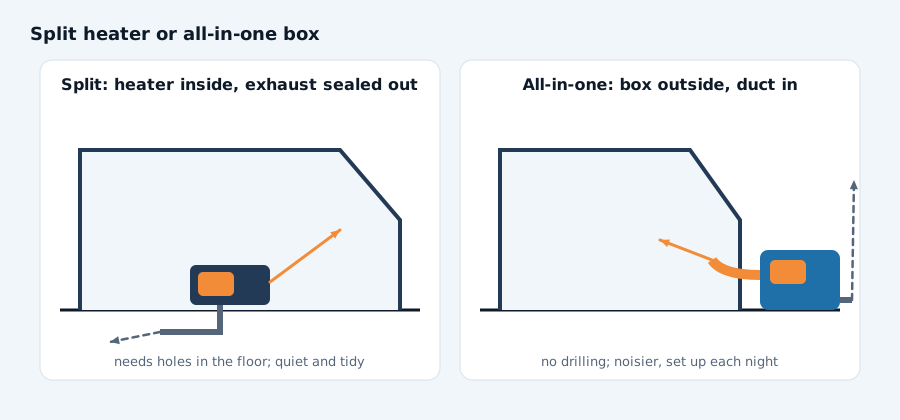
No drilling, but the box stays outside
The TB MAX2 is an all-in-one, with the heater, the 7.9 L (2.1 gal) tank and the controls in one toolbox case. It still burns diesel and makes exhaust, so it is not a heater you set on the van floor and switch on.
The safe setup is the box outside on level ground beside the van, feeding warm air in through its duct via a window insert or a sealed port. The other route is the box inside with its exhaust sealed and piped outside, which is more work than it sounds.
Aim the exhaust downwind, away from every opening and from the box’s own air intake, and keep it clear of snow. HCALORY wraps the exhaust in a heat sleeve because it reaches 752 °F, so keep it away from dry grass and anything that melts.
The listing puts the box at about 28 lb, a heavy thing to carry out and set up each night. Our guide to carbon monoxide in a van shows where the gas gets in when a box or its exhaust sits too close.
110 V at the campsite, 12 V off grid
Power can come from 12 V, 24 V or a 110 V AC hookup. Off grid it draws from your house battery like any diesel heater, a modest load while running but a heavy one from the glow plug, which pre-heats for a minute at each start.
Plug it into a campsite hookup and the 110 V supply takes that load off the battery. For anyone who winters at RV parks with shore power, that is the strongest reason to pick this box over a 12 V-only heater.
On 12 V, size the battery for the overnight run plus each start and cool-down purge. Our guide on how much battery a diesel heater uses overnight does the sums, and a flat or tired battery is the usual culprit when a heater refuses to start.
Fuel and the 7.9 L tank
HCALORY lists up to 65 hours on the minimum setting at 0.12 L/h, which matches the 7.9 L tank. The maximum fuel rate is not listed in what we read, so there is no way to work out run time on high.
At that minimum rate, an eight-hour night burns about 1 L, a quarter of a gallon. The listing names a dual-valve fuel cap, but a box full of diesel is still best carried upright and kept out of your bedding between stops.
Use winter-grade diesel in hard frost, since summer diesel can gel, and never fill it with gasoline. Refuel with the heater switched off and cooled down, outside the van.
Cold starts and altitude mode
The glow plug pre-heats for one minute, and HCALORY promises stable ignition down to −4 °F. Warm air arrives in about 3.5 minutes, with the outlet reaching 212 °F within 5 minutes, per the maker.
Below −4 °F the listing makes no promise, so in a deep northern winter plan for slow or failed starts. A fully charged battery, or the 110 V supply, gives the glow plug its strongest chance.
The listing promises automatic altitude adjustment up to 16,400 ft. At altitude a sea-level setup over-fuels and smokes, so watch the exhaust on your first mountain night and read our guide to altitude and diesel heater smoke.
App control and the noise question
The remote doubles as an indoor thermostat that senses room temperature, set between 65 and 75 °F with a ±3.6 °F band from the panel, the remote or the app. HCALORY quotes 54.6 dBA from a filtered silent pump and a muffler, a maker figure owners have yet to confirm.
With the box outside, the fan and the dosing pump sit beyond the van wall, which keeps their sound away from your pillow. What comes inside is mostly warm air moving through the duct, though campsite neighbors will hear the box itself.
Safety checks before the first night
The listing names overheat, overvoltage and flame-out cut-off, plus an IPX4 splash-proof rating, which covers rain and spray rather than standing water. Those features protect the heater, and none of them watches the air you breathe. The listing itself warns that the exhaust must go outdoors.
Fit a battery-powered CO alarm near where you sleep, and never sleep with the box inside the van. Never pull the plug or cut the battery mid-run; switch it off and let it finish its purge.
Check the exhaust each evening for snow and leaves, and stand the box and duct where a gust cannot knock them over. For the full checklist, see our nine safety rules for a diesel heater.
What owners report so far
The TB MAX2 is a new listing with few owner reports yet, so its long-term record is unknown. It has a new SUS310S alloy core and an aluminum body, so reports on older HCALORY toolbox models do not carry over neatly.
Buy with the return window in mind and run it hard in the first weeks. Watch for continuous smoke or failed starts, and check the warranty terms on the listing, because the text we read did not spell them out.
Against the VEVOR box and the split heaters
The VEVOR all-in-one, our top pick, is the cheaper box, in the $ band, with a 5 L tank and 12 to 24 V only. It is lighter and simpler, and our HCALORY vs VEVOR heater box comparison weighs the extras against the price.
If the heater will live in the van all winter, a split unit is the tidier answer. The OBAKL 2KW is sized for a van, and the Espar D2L is our premium pick for a permanent install.
See the TB MAX2 on our shortlist, or read the full comparison of diesel heaters for vans to weigh all five boxes and kits together.
For the camper who moves and plugs in
If you want one heater for the van, the tent and the trailer, and you often camp with a 110 V hookup, the TB MAX2 is the most capable box here. Keep it outside with the exhaust pointed away, run a CO alarm inside, and give a young listing a careful first month.


