How much battery a diesel heater uses overnight
A diesel heater gets its warmth from fuel, but it needs your battery to light, run and shut down. The running draw is small and the starts are not, and a tired battery is the most common reason a heater quits on a cold night.
Where the power goes
A diesel heater gets its heat from fuel, not from the battery. The battery runs the fan and the dosing pump, powers the controller and heats the glow plug that lights the burner.
Once the flame is going, the draw is small, often 1 to 3 A at 12 V. The glow plug is the big load, drawing far more for the first minute or two of each start and again during the cool-down purge.
A heater that starts once and runs all night is easy on a battery. One that cycles on and off by thermostat, lighting again every hour or so, can spend a large share of its power on starts.
What the makers publish
- Espar Airtronic D2L
- A few dozen watts at most while running, by Eberspächer’s published D2 figures, which vary by generation; the AS3 listing gives no draw
- VEVOR 8KW split
- 12 V; running draw not stated on the listing
- VEVOR All in One
- About 3 A on 12 to 24 V DC, per the listing
- OBAKL 2KW
- 12 V; running draw not stated in what we read
- HCALORY TB MAX2
- 12 V, 24 V or 110 V AC; DC draw not stated in what we read
Gaps like these are common on budget listings. The Autoterm Air 2D, a 2 kW rival with a thin US listing, publishes 10 to 29 W, the same few-dozen-watt class as the Espar.
Working out a night’s draw
The sum is plain arithmetic. Multiply the running current by the hours, then add a margin for each start and for the purge at the end.
| Running draw at 12 V | 8 hours | 12 hours |
|---|---|---|
| 1 A | 8 Ah | 12 Ah |
| 2 A | 16 Ah | 24 Ah |
| 3 A | 24 Ah | 36 Ah |
Those figures cover running only. Each start adds a burst for the glow plug, so a heater that relights several times a night needs more headroom than the table shows, and a fan on high draws more than one on low.
A heater that runs 10 hours at 2 A takes about 20 Ah plus its starts. That is a modest load for a house battery, but a serious dent in an old starter battery that also has to crank the engine.
Sizing the house battery
Treat the heater as one load among several. Lights, a fridge, phones and a roof fan all draw from the same bank, and the heater still has to light on the coldest morning.
A lead-acid battery should not be drained deep night after night, and it gives less in the cold. A lithium bank tolerates deeper use, but many lithium batteries won’t charge below freezing, so mount it inside the heated space.
Leave a healthy margin above the heater’s low-voltage cutoff. A battery that reads fine at noon can sag below it during a glow plug start at dawn, and the heater then refuses to run.
Fuel and power over the same night
Diesel and amp hours run side by side. The chart shows how much diesel each heater burns per hour by maker figure, and the higher settings that burn more fuel also spin the fan faster.
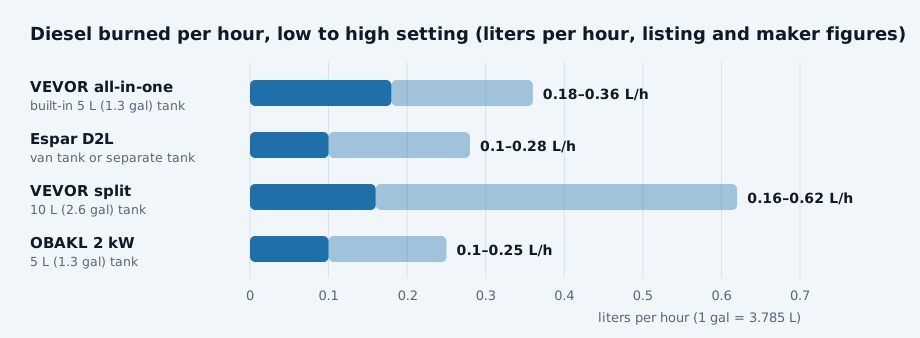
VEVOR puts its split heater at about 1 gallon per night, with a 10 L tank lasting up to 16 hours. HCALORY claims up to 65 hours from the 7.9 L tank of the TB MAX2 at its 0.12 L/h minimum, though a heater that lives on minimum soots up.
Our van heater size guide explains why a 2 kW unit in a well-insulated van runs steadily in its middle range. Steady running means fewer starts, which saves diesel and amp hours alike.
Habits that protect the battery
- Switch off with the controller and let the purge finish before you cut the main power
- Avoid short on-off cycles; a lower steady setting needs fewer starts
- Charge the bank fully before a cold night, by solar, alternator or shore power
- Check cable sizes and connections, since a thin or loose cable sags under the glow plug load
- Fit the fuse the manual specifies, close to the battery
Never cut the power while the heater runs, and never wire it to a switch that could. The purge carries heat away from the exchanger and clears the chamber, so a hard cut can damage the heater and leave it hard to start next time.
When the battery is why it won’t start
A weak battery is the most common reason a diesel heater fails to light or throws a low-voltage error. The glow plug pulls the voltage down at the very moment the controller checks it.
Charge the battery, check the terminals and try again before you strip anything apart. The guide to a diesel heater that won’t start takes it from there.
Noise, wiring and the power budget
Fan speed links your battery to your sleep. A fan on high draws more current and makes more noise, and the guide to making a diesel heater quieter covers settings that help both.
Wiring belongs on the safety checklist too. Keep cables clear of the hot exhaust and away from fuel lines, as the diesel heater safety rules set out.
Mains power, and choosing a heater
At a campground with a hookup, a heater that runs on 110 V takes the battery out of the picture. The HCALORY TB MAX2 review covers the one heater here that takes 12 V, 24 V or 110 V, though it is an all-in-one box that stays outside the van.
The guide to diesel heater brands weighs a premium maker against the budget names on build and support. If you are still deciding which diesel heater to buy, the sizing and fuel section and the full list of picks set out all five.
If your battery bank is small
The Espar D2L draws a few dozen watts at most while running by Eberspächer’s published D2 figures, and its 2 kW size suits steady overnight running rather than constant restarts. It costs several times a budget heater and needs a proper install, so it pays off most in a van you heat every winter.