Best Diesel Heater for a Van

Frost on the inside of the windows?

Then skip the endless scroll of look-alike heaters. We picked five after reading the listings, the makers’ figures, the install manuals and what van owners report after a winter on the road. Our top pick needs no hole in the floor, and the other four cover every build from a quiet floor-mounted kit to a box on 110 V, each with its catch said plainly.

  • Dry heat all nightA sealed flame and a few cups of diesel keep a well-insulated van warm till morning
  • The exhaust goes outsideA careful install and a battery CO alarm belong with every heater here

In a hurry? Our top pick is the VEVOR 8KW All in One, a box with its own 5 L tank that needs no drilling, burns 0.18 to 0.36 L/h and sits in the cheapest price band. It stands outside, with only its warm-air duct coming into the van.

Compare all 5 heaters

If you only have a minute

Which diesel heater should you buy?

Say a friend asked us at a campground which heater to get for their van before the first frost. This is what we would tell them.

For most vans, the VEVOR all-in-one. It needs no hole in the floor, sits in the cheapest band of the five and runs on 12 or 24 V. The box stands outside with a duct coming in, and it needs setting up each night.

Building the van for good? The Espar Airtronic D2L is 2 kW, quiet and built to run every night for years, at several times the price and with a proper install. On a tight budget, the VEVOR 8KW split is the classic cheap install.

Want 2 kW fitted for less than the Espar? The OBAKL 2KW is sized right on a young listing (the two 2 kW heaters, compared). Camping on hookups? The HCALORY TB MAX2 is a bigger box that also runs on 110 V.

Whichever you pick, read where carbon monoxide gets into a van and the eight things the listing leaves out before the first night.

Our top pick

The diesel heater we would pick for most vans: VEVOR All in One

Not the best built and not the quietest. It is the one most van owners can afford, run without drilling a hole and take along when they change vans.

VEVOR 8KW all-in-one portable diesel heater in one case with a built-in 5 liter tank and a color display Our top pick

VEVOR 8KW All in One, DC 12–24 V

Price band $ The cheapest of the five, with plenty of owner reviews

The VEVOR all-in-one puts the heater, a 5 L (1.3 gal) tank and the controls in one case. Nothing gets drilled, bolted or plumbed into the van, so it suits a leased or rented van, or one you have not converted yet.

It sits in the lowest price band of our five and has far more owner feedback than any other heater in the lineup. It moves between the van, a tent and the garage, and at 0.18 to 0.36 L/h one tank goes a long way.

That freedom comes with a routine. The box stands outside, or has its exhaust sealed and piped out, with only the warm-air duct entering the van. It needs setting up each night, and a box is noisier than a heater fitted under a seat.

Heat output
8 kW rated by VEVOR, about 3.6 kW of fuel at the top rate (our arithmetic)
Rated area
161 to 215 sq ft
Fuel use
0.18 to 0.36 L/h (maker)
Tank
5 L (1.3 gal) built in, with a fuel gauge
Power
DC 12 to 24 V, about 3 A (listing)
Altitude
Below 9,843 ft, no automatic mode stated
Controls
98 ft remote and LCD, 32 to 104 °F
Install
None, box outside and a duct in
Price band $ under $150 · price on Amazon

Your setup, night by night

With a box heater, most smoke, fumes and error complaints trace back to how it is set up. This is the order that keeps the exhaust out of your van.

Outside the van

  • Stand the box on level ground beside the van, sheltered from driving rain
  • Point the exhaust away from the van, its doors and windows, and the duct
  • Top up the 5 L tank with winter diesel while the box is off and cool
  • Clear snow and leaves from the exhaust before every start

Then bring the heat in

Inside the van

  • Pass the warm-air duct in through a sealed window insert or port
  • Keep the duct short and insulated where it crosses the gap
  • Power it from a house battery, not the starter battery
  • Fit a battery CO alarm in the sleeping area
  • Switch off at the remote and let it purge, never at the battery

Why we picked it, and what it lacks

Why we picked it
  • No drilling and nothing permanent in the van
  • The lowest price band of the five
  • The most owner feedback in our lineup
  • Low fuel use, 0.18 to 0.36 L/h per VEVOR
  • Fuel gauge, leak-proof cap and a heat-shielded exhaust
What it lacks
  • A place inside the van, the box lives outside
  • Quiet, effortless nights, it needs setting up each evening
  • An automatic altitude mode, it is rated below 9,843 ft
  • A clean record, some owners report error codes and shutdowns
  • A true 8 kW, its fuel rate works out near 3.6 kW

Between us, before you order

A box heater is safe for the same reason a fitted one is, a sealed flame with the exhaust outside. Run it in a closed van with the exhaust inside and it can kill, so the box stays out or the exhaust is piped out, every night.

The 8 kW on the label is a size class. At 0.36 L/h it burns about 3.6 kW of fuel energy, by our arithmetic from diesel’s roughly 10 kWh per liter, and the listing names no altitude mode. Above 9,843 ft, look at another heater.

What owners report

For many owners it does what the listing promises and keeps a trailer warm through cold spells. For weekends, a winter of travel or a van that is still a bare shell, that is the job most buyers need done.

The complaints are error codes and shutdowns on some units, and a few found it could not heat a small shed. Clean winter diesel, a charged battery and a spell on high now and then help it keep lighting. Keeping it clean.

Buy it if

You want diesel heat this winter without drilling the floor, in a van you rent, lease or have not built out yet, and you will set the box up outside each night.

Skip it if

Ready for a warm van on the next cold night?

Plan for a level spot outside, a short insulated duct, a house battery and a battery CO alarm by the bed. Do that each evening, and the VEVOR all-in-one is the heater we would tell most van owners to start with.

Size and fuel

Three heater sizes, and the van each one suits

Every heater here burns diesel in a sealed chamber. What differs is how much heat it makes once you do the fuel arithmetic, and how long a gallon lasts. Our top pick wears an 8 kW label but burns like a van-sized heater.

Van · insulated campervan

Right for most vans

Espar D2L, OBAKL 2KW

2 kWabout 6,800 BTU

A common rule of thumb for a well-insulated campervan. The heater runs in its middle range, which keeps it clean and quiet.

Van · big, bare or very cold

More heat, more diesel

VEVOR 8KW split

4 to 5 kWabout 14,000 to 17,000 BTU

A high-roof van, thin insulation or deep cold may want this much. The VEVOR split’s top rate of 0.62 L/h works out near 6 kW of fuel energy (our arithmetic).

Label · the “8 kW” boxes

A number on the box

VEVOR all-in-one, HCALORY TB MAX2

“8 kW”a size class, not a measurement

Diesel holds about 10 kWh per liter. Our top pick, the VEVOR box, burns at most 0.36 L/h, so it feeds in about 3.6 kW of fuel (our arithmetic). That sits between the two van sizes above, whatever the label says.

How long one gallon of diesel lasts

  • On the high setting
  • On low, past the edge of the scale
0 h246810121416

Our arithmetic from the makers’ fuel rates: one US gallon (3.785 L) divided by liters per hour. The Espar rates are Eberspächer’s published D2 figures. VEVOR itself quotes up to 16 hours per 10 L tank for the split.

  1. Size the heatMatch the kilowatts to your van and its insulation, not to the biggest label. Which size
  2. Plan the fuelA separate tank keeps it simple, a standpipe taps the van’s own tank. Feeding the heater
  3. Route the exhaustOut through the floor, or from a box set outside, always away from doors, windows and the intake. Installing it
  4. Carry an alarmA battery CO alarm is the one thing that warns you before you feel ill. Carbon monoxide

Running it from a house battery? Our battery guide works out what a night of heat draws, and why the start costs more than the run.

How to choose

How to pick the right diesel heater for your van

Six points decide it. Your van, the cold you travel in and how you will install it matter more than the number on the box.

Heat output and van size

A well-insulated campervan usually needs about 2 kW. An oversized heater idles on low all night and soots up. Size your heater.

Split kit or all-in-one

A box like our top pick, the VEVOR all-in-one, needs no drilling but stands outside, with only the warm-air duct coming in. A split kit like the Espar lives inside with its exhaust through the floor. Split or box.

Fuel supply

Use the heater’s own tank or a standpipe in the van’s tank. Either way, winter diesel in hard frost and never gasoline. Fuel options.

Altitude

Thin air makes a sea-level heater run rich and smoke. The Espar, the VEVOR split, the OBAKL and the HCALORY adjust by themselves. Our top pick, the VEVOR box, has no stated altitude mode and is rated below 9,843 ft. Heat in the mountains.

Noise and controls

The fan and the ticking dosing pump are what you hear in bed. A damped pump, rubber mounts and silencers help a lot. A quieter night.

Power and battery

Running draw is low, but the glow plug pulls hard at each start. A weak battery is the usual reason a heater won’t light. Battery sizing.

The 5 heaters

Five van diesel heaters, side by side

Our top pick first, then the premium Espar for a permanent build, the budget split, the other 2 kW heater and the box that runs on 110 V. Each card names the catch.

VEVOR 8KW all-in-one portable diesel heater in one case with a built-in 5 liter tank and a color display Our top pick

VEVOR 8KW All in One

The heater we would tell most van owners to start with.

  • TypeAll-in-one box with a 5 L (1.3 gal) tank
  • Heat8 kW rated, 161 to 215 sq ft
  • Fuel0.18 to 0.36 L/h (maker)
  • PowerDC 12 to 24 V, about 3 A
  • AltitudeBelow 9,843 ft, no automatic mode stated
  • Ideal forRented, leased or unbuilt vans, weekends, winters on the move

Good to know: The box stands outside, or its exhaust is sealed and piped out, and it needs setting up each night. Some owners report error codes and shutdowns. Carbon monoxide.

Read the full VEVOR all-in-one review

$under $150
Eberspächer Espar Airtronic AS3 D2L diesel air heater kit with the heater, fuel pump, ducting and exhaust parts Premium install

Espar Airtronic AS3 D2L

The heater to fit for good, if you will pay for it.

  • TypeSplit kit, exhaust and intake through the floor
  • HeatUp to 2 kW (6,824 BTU), stepless
  • FuelAbout 0.10 to 0.28 L/h, van tank or own tank
  • AltitudeSensor built in, up to 18,000 ft
  • Warranty2 years or 2,000 hours
  • Ideal forFull-time vans with a permanent build

Good to know: It costs several times a budget heater, the kit lacks a tank or standpipe, and a few owners report pump or sensor faults with slow US service. Espar against VEVOR.

Read the full Espar D2L review

$$$over $500
VEVOR 8KW orange diesel air heater with a separate 10 liter fuel tank, LCD controller and remote Budget install pick

VEVOR 8KW Bluetooth split

The cheap way to a heater that stays in the van.

  • TypeSplit kit, own 10 L (2.6 gal) tank
  • Heat8 kW rated, nearer 6 kW of fuel energy
  • Fuel0.16 to 0.62 L/h, up to 16 h per tank (maker)
  • AltitudeAutomatic, up to 18,045 ft
  • ControlsBluetooth app, remote, LCD, thermostat mode
  • Ideal forBigger vans and trailers on a tight budget

Good to know: Owners report pump failures and a thermostat that reads off, and the manual is poor. It is big for a small van, so run it on high now and then. Fitting it safely.

Read the full VEVOR 8KW review

$under $150
OBAKL 2KW diesel air heater with a red aluminum housing, talking LCD controller and fuel tank Right-sized 2 kW

OBAKL 2KW, aluminum housing

The size the Espar is, for a lot less.

  • TypeSplit kit with a 5 L tank, model OAH-B1
  • Heat2 kW, red all-aluminum shell
  • Fuel0.1 to 0.25 L/h, own tank or van tank
  • Altitude“Plateau Mode”, automatic up to 18,045 ft
  • ControlsTalking LCD switch, LCD remote up to 160 ft, timer
  • Ideal forSmall, well-insulated vans

Good to know: A young listing with few owner reports yet and no stated warranty. The maker rates it from −40 °F to 122 °F. Why 2 kW is enough.

Read the full OBAKL 2KW review

$$$150 to $500
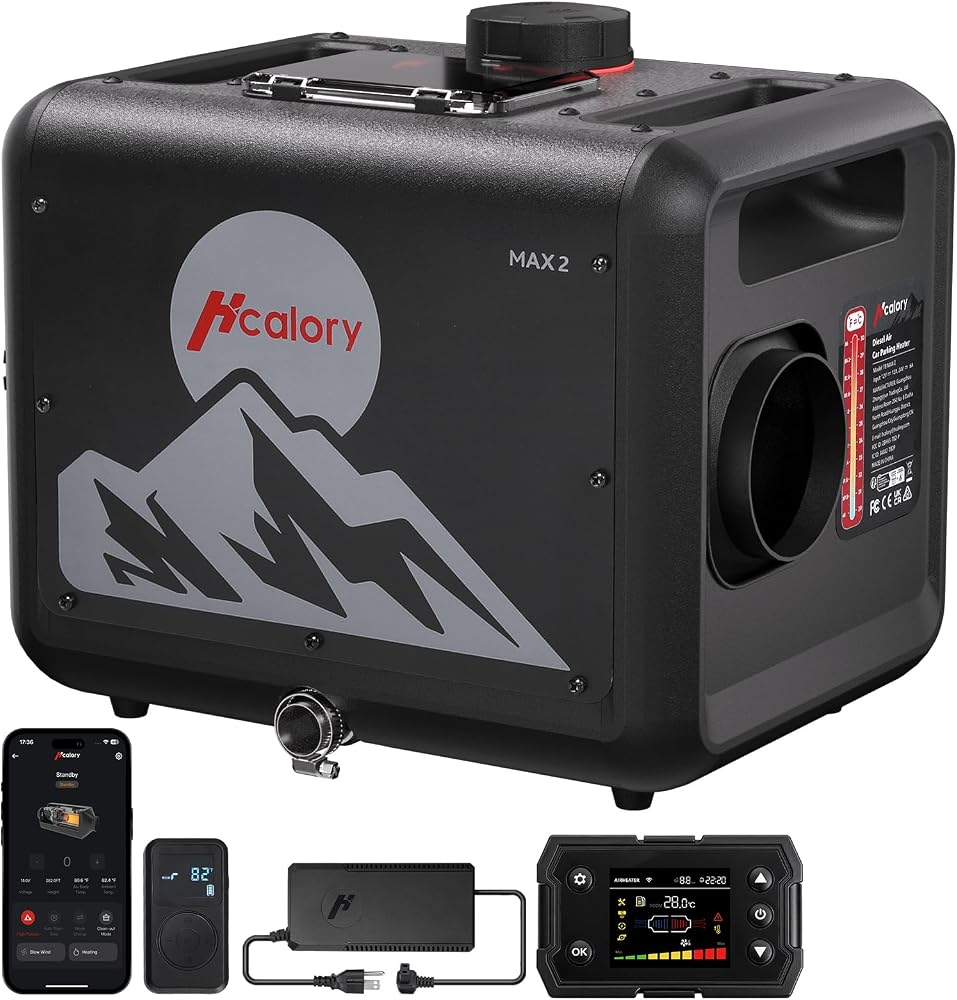
HCALORY TB MAX2 toolbox-style all-in-one diesel heater with a 7.9 liter tank and carry handle Runs on 110 V too

HCALORY TB MAX2

A toolbox heater that plugs into shore power.

  • TypeAll-in-one toolbox case with a 7.9 L tank
  • Heat8 kW rated, 215 to 289 sq ft
  • FuelFrom 0.12 L/h, up to 65 h per tank on minimum
  • Power12 V, 24 V or 110 V AC
  • ExtrasApp, auto altitude to 16,400 ft, carbon cleaning
  • Ideal forCampsites with hookups, workshops, trailers

Good to know: About 28 lb, few owner reports so far on a new listing, and like every box it belongs outside. Its exhaust reaches 752 °F. Power for a night.

Read the full HCALORY TB MAX2 review

$$$150 to $500

Honest note: these are Amazon affiliate links. As an Amazon Associate we earn from qualifying purchases at no cost to you, and it changes nothing about the order or the catches we name.

Before you buy

Eight things about van diesel heaters no listing prints in big letters

None of these sits at the top of a product page, and all eight shape your first winter with a diesel heater in the van.

What you should know

  1. The exhaust is the whole safety story. A sealed flame is safe until the exhaust leaks, rusts or ends under a door, near a window or in a snowbank. Where CO gets in
  2. A box heater stays outside. Our top pick is a box, and it still burns diesel and gives off exhaust. Keep it outside, or seal the exhaust and run it out through a pipe, and never sleep with it in the van
  3. A separate CO alarm is not optional. Put a battery alarm in the sleeping area. A heater’s own sensor, where it has one, is no substitute. Safety rules
  4. Never cut the power mid-run. Switch off at the controller and let the fan finish its cool-down purge. Pulling the plug cooks the burner and coats it in carbon
  5. Summer diesel gels. In hard frost, use winter-grade diesel or your area’s winter blend, and never put gasoline in a diesel heater. Fuel supply
  6. Too big runs dirty. An “8 kW” heater in a small van idles on low and soots up. Let it run on high at regular intervals. Carbon and smoke
  7. Altitude changes the mix. Thin air makes a sea-level heater run rich and smoke. Use automatic compensation or the manual high-altitude setting. Heat at altitude
  8. A weak battery is the usual no-start. The glow plug draws hard for the first minute or two, and a tired battery throws a low-voltage error. Start-up fixes

Everything in one table

Five van diesel heaters, catch included

Each row puts a heater’s strength right next to its catch.

Swipe the table sideways to see all columns →

Heater Ideal for Band Type Heat and area Fuel and run time Strength and catch View
VEVOR 8KW All in One (our top pick) Most vans, no drilling $under $150 All-in-one
box outside
8 kW rated, 161 to 215 sq ft 0.18 to 0.36 L/h, 5 L tank No drilling, cheapest of the five, most owner feedback. Must stand outside, set up nightly, error codes reported.
Espar Airtronic AS3 D2L (premium install) Permanent builds, full-time $$$over $500 Split kit
altitude sensor
Up to 2 kW (6,824 BTU); 0.85 to 2.2 kW by Eberspächer’s D2 figures About 0.10 to 0.28 L/h (Eberspächer D2), van tank or own Built to last, quiet, right size. Costly, needs a proper install.
VEVOR 8KW Bluetooth split Bigger vans and trailers $under $150 Split kit
auto altitude
8 kW rated, 215 to 269 sq ft 0.16 to 0.62 L/h, up to 16 h per 10 L tank Cheap, complete kit, app. Pump and thermostat faults, poor manual.
OBAKL 2KW Small insulated vans $$$150 to $500 Split kit
aluminum housing
2 kW 0.1 to 0.25 L/h, 5 L tank Right size, talking LCD. Young listing, few owner reports yet.
HCALORY TB MAX2 Campsites with hookups $$$150 to $500 All-in-one
12/24/110 V
8 kW rated, 215 to 289 sq ft From 0.12 L/h, up to 65 h per 7.9 L on minimum Runs on mains, app, auto altitude. Heavy, new, box stays outside.

Figures from the Amazon.com listings and, where marked, from the maker. “8 kW” is the makers’ rating, not a measurement. Only the price Amazon shows at checkout counts.

Ready for the first frost

Warm tonight with the VEVOR all-in-one

For most vans, this is the heater we would buy first. It needs no hole in the floor, costs the least of the five and goes with you when you change vans.

Give it a level spot outside, a short sealed duct, a house battery and a battery CO alarm. Then it will keep the frost off the inside of the glass while you sleep.

$

under $150 · all-in-one box · VEVOR

  • ✓ No drilling, heater and 5 L tank in one case
  • ✓ 0.18 to 0.36 L/h per VEVOR
  • ✓ DC 12 to 24 V at about 3 A
  • ✓ Fuel gauge, leak-proof cap, shielded exhaust

Good to know

Why a diesel heater acts the way it does, in the cold and the mountains

A few minutes of background makes the quirks of a diesel heater in a van much easier to live with.

A diesel air heater sprays a trickle of fuel into a sealed burner, lights it with a glow plug, and blows cabin air over the hot metal around it. The flame and your air never meet.

01Why it is safe, and when it isn’t

Combustion air comes in through one pipe and exhaust leaves through another, both outside. A cracked exchanger, a loose exhaust or an outlet beside a door breaks that seal. Where it leaks.

02Why it smokes in the mountains

Thinner air carries less oxygen. A heater set for sea level keeps pumping the same diesel, runs rich, smokes and cokes up unless it trims the fuel.

03Why it carbons up on low

On its lowest setting the burner runs cool, and unburned fuel leaves soot behind. A long run on high now and then burns most of it off.

A diesel heater lives on three things: clean air in, exhaust out, and a battery strong enough to start it.

04Why the start drains the battery

Once lit, a heater draws only a few amps. The glow plug pulls much more for the first minute or two and again during the purge, so a weak battery fails right there.

~10 kWhEnergy in a liter of diesel

2 kWEnough for most insulated vans

9,843 ftThe ceiling for our top pick box

1 to 3 ATypical draw once it is running

Want the full safety picture? Read the nine safety rules before your first cold night.

Questions and answers

Frequently asked questions about van diesel heaters

Thirteen questions that come up again and again, with full answers.

What is the best diesel heater for a van?

For most vans, the VEVOR 8KW All in One. It needs no drilling, sits in the cheapest band and has plenty of owner reviews, as long as the box stands outside with a duct in. For a permanent build, the Espar Airtronic D2L. All five sit in the comparison table.

Why is a box heater your top pick and not the Espar?

Because most people asking can use it tonight. It needs no hole in the floor, costs a fraction of the Espar and moves between van, tent and garage. The Espar is better built and quieter, so it stays our pick for a permanent install. Espar or VEVOR.

Is a diesel heater safe to sleep with in a van?

A properly installed split heater is, and so is a box set outside, because the flame is sealed and the exhaust leaves outside. The danger is a leaking exhaust, an outlet near a door, or a box run inside. Add a separate battery CO alarm by the bed. The nine rules.

What size diesel heater does a van need?

A common rule of thumb says about 2 kW for a well-insulated campervan, and 4 to 5 kW for a large, thinly insulated van or very cold climate. An oversized heater idles on low and carbons up. Size it for your van.

How much diesel will a heater burn in one night?

On low, very little. Our top pick burns 0.18 to 0.36 L/h per VEVOR, and the Espar about 0.10 to 0.28 L/h by Eberspächer’s D2 figures. Ten hours on low uses roughly 1 to 2 liters on any of them.

Will a diesel heater drain my van battery?

Once lit, most pull 1–3 A at 12 V. Starts and purges draw far more through the glow plug, so a weak battery fails there first. Never cut the power mid-run. What a night costs.

Can I use an all-in-one diesel heater inside my van?

Only with the exhaust sealed and piped out. The box still burns fuel, so otherwise it sits outside and sends warm air in through its duct. That goes for our top pick too. Never sleep with one in the van.

Is an 8 kW diesel heater really 8 kW?

Not in the fuel. A liter of diesel carries about 10 kWh, so 0.62 L/h at most means roughly 6 kW of fuel energy going in, and our top pick’s 0.36 L/h about 3.6 kW. That is our arithmetic from the makers’ own rates. Treat 8 kW as a size class.

Why does my diesel heater smoke at altitude?

Thin air means less oxygen, so a heater set for sea level runs rich. Some, like the Espar and the VEVOR split, compensate by themselves. Our top pick states no altitude mode and is rated below 9,843 ft. The fix.

Should I tap the van’s fuel tank or use a separate tank?

A separate tank is simpler and leaves the van’s tank alone. A standpipe in the van’s tank saves refills, and since it does not reach the bottom, the heater stops before you run the van dry. Both options.

Why won’t my diesel heater start?

Most often a weak battery, then air or old fuel in the line, gelled summer diesel, a carboned glow plug or the wrong altitude setting. Read the error code first. Eight fixes.

Why don’t you show prices?

They change often, so a fixed price here would soon be wrong. We give a band instead ($ under $150, $$ $150 to $500, $$$ over $500), and the button takes you to the product page, where the price at checkout counts.

Did you test these heaters yourselves?

No, and we say so openly. We read the listings, the makers’ figures, the install manuals and owner reports. Where sources disagree or a figure comes from the maker, we show where each number comes from.

Reviews

A closer look at each heater

Each review sets the full specs next to what owners report, and names the rivals worth a look.

Head-to-head

Torn between two? Four matchups, settled

Split against box, small against big, the two boxes against each other, and the two 2 kW heaters.

Read before you buy

Guides to safe, steady heat in your van

Ten background guides, three buying guides and a glossary. Each gives the long answer instead of the short one.