What size diesel heater your van needs
Most diesel heaters sold for vans carry an 8 kW label, yet most insulated campervans need about a quarter of that. This guide shows how to size a heater to your van, what the kW figures on the listings leave out, and why a heater that is too big brings problems of its own.
What a kW rating tells you
Diesel heater makers rate output in kilowatts (kW), the rate at which the heater puts heat into your cabin air on its top setting. One kW is about 3,412 BTU per hour, so a 2 kW heater gives roughly 6,800 BTU.
Most heaters also have a low setting, and that number matters as much as the top one. Once the cabin is warm, a van heater spends most of the night ticking over, so its bottom figure decides how gently it can hold a temperature.
A common rule of thumb for vans
A well-insulated campervan usually needs about 2 kW. That is a common rule of thumb among van builders, and it covers a panel van or high-roof conversion on most winter nights.
A large or poorly insulated van may want 4 to 5 kW, and so may any van that spends weeks in hard cold. In those cases a 2 kW unit can run flat out for hours and still lose ground on a windy night.
What pushes you up a size
- Insulation: bare metal walls lose heat far faster than walls lined with foam or wool
- Glass: big side windows and an uncovered windshield are the largest cold spots in most vans
- Volume: a long high-roof van holds much more air than a compact panel van
- Climate: nights well below 0 °F and strong wind eat into any heater’s reserve
- Doors: a sliding door that opens often dumps the warm air every time
Insulation beats extra kilowatts. Window covers and a thermal curtain behind the cab often do more for a cold van than a heater twice the size.
The five heaters by rated output
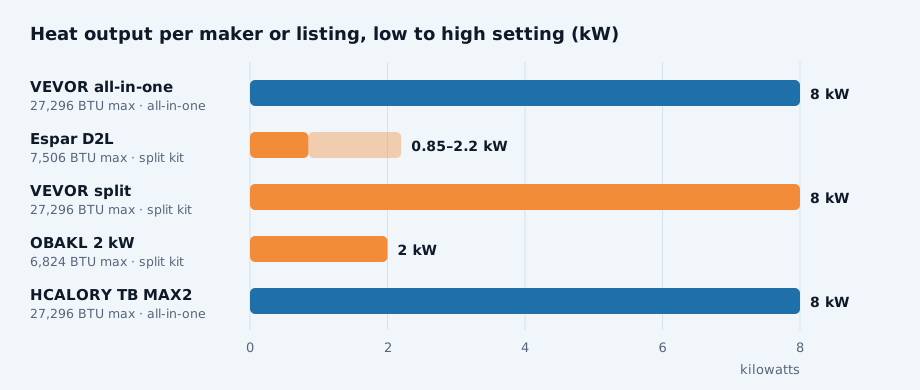
The figures below come from the listings and the makers. Two of the five are rated at 2 kW, and the other three carry the 8 kW label common on budget heaters.
| Heater | Type | Rated output | Rated area | Van it suits |
|---|---|---|---|---|
| Espar Airtronic D2L | Split kit | 2 kW (6,824 BTU); Eberspächer’s D2 figures 0.85–2.2 kW | Not given | Insulated campervan you sleep in |
| VEVOR 8KW split | Split, 10 L tank | 8 kW (maker) | 215–269 sq ft | Big van, cargo trailer or workshop |
| VEVOR all-in-one | Box, 5 L tank | 8 kW (maker) | 161–215 sq ft | Most vans, box outside and duct in, no drilling |
| OBAKL 2KW | Split, 5 L tank | 2 kW | Not given | Insulated campervan on a middle budget |
| HCALORY TB MAX2 | Box, 7.9 L tank | 8 kW (maker) | 215–289 sq ft | Box outside, at sites with 110 V hookup |
A van floor is usually well under the rated areas above. On paper that makes every heater in the table look big enough, so the useful question is how low each one can idle.
What an 8 kW label hides
Diesel holds roughly 10 kWh of energy per liter. The VEVOR split heater’s maximum fuel use is 0.62 L/h, so simple arithmetic puts about 6 kW of fuel energy into the burner at most, before any losses.
That makes the 8 kW figure a marketing number rather than a measurement. The VEVOR split behaves more like a 5 to 6 kW heater, two or three times what an insulated campervan needs.
The VEVOR all-in-one, our top pick for most vans, tops out at 0.36 L/h. The same arithmetic gives about 3.6 kW of fuel energy at most and about 1.8 kW on its 0.18 L/h low setting, a gentler spread than its label suggests.
The 2 kW heaters sit at the other end. Eberspächer’s published D2 figures of 0.10 to 0.28 L/h work out to about 1 to 2.8 kW of fuel energy for a 2.2 kW top output, and the OBAKL’s listed 0.25 L/h top rate gives about 2.5 kW for its 2 kW label.
Why too big causes trouble
An oversized heater reaches your set temperature fast, then spends the night on its lowest setting or cycling on and off. Diesel heaters burn dirty when they idle that low for long, and soot builds up in the burner and exhaust.
Soot leads to white smoke, hard starts and eventually a heater that will not light. Our guide to white smoke and carbon covers the signs and the cleaning routine.
Each restart also costs power, since the glow plug draws heavily for the first minute or two. A heater that cycles all night drains more battery than one that runs steadily, as our overnight battery guide explains.
Matching the heater to your van
- Insulated panel or high-roof campervan you sleep in: a 2 kW split heater such as the Espar Airtronic D2L or the OBAKL 2KW
- Long van with thin insulation, or weeks below 0 °F: a 4 to 5 kW class heater, or better insulation first
- Cargo trailer or workshop heated for a few hours: a budget 8 kW split works harder there and idles less
- No drilling allowed, or a van you move between uses: an all-in-one box standing outside, with only the warm-air duct coming in
Whatever size you choose, it has to go in properly. Our guide to fitting a heater through the floor covers the mounting plate and exhaust, and the fuel supply guide weighs the van’s tank against a separate one.
Why 2 kW suits a fitted heater
For a permanent install, a 2 kW heater in an insulated van runs in its middle range most of the night, which keeps it cleaner and quieter. Eberspächer’s published D2 figures add stepless output down to 0.85 kW, so the Espar can hold a small cabin warm without constant on-off cycling.
The trade is cost. The Espar sits in the $$$ band, several times the price of a budget heater, while the OBAKL offers the same 2 kW in the $$ band from a young listing with few owner reports yet.
All five sit in our comparison of the best diesel heater for van life, with output and fuel use side by side in the comparison table and sizing notes under how it works.
For a permanent install in an insulated campervan
The Espar Airtronic D2L is rated at 2 kW, steps down to about 0.85 kW per Eberspächer’s D2 figures and has an altitude sensor good to 18,000 ft. It costs far more than our top pick, the all-in-one, and needs a careful install, but it is sized for a van rather than a workshop.