Espar Airtronic D2L, the premium van heater
The Airtronic AS3 D2L is the premium choice for a van you are building for good. It is sized for a van, quiet at night and built by a long-established German heater maker, at several times the price of our no-drill top pick. We did not fit one ourselves, so this review weighs the listing and Espar’s figures against what owners report.
 Premium install
Our verdict
The Espar D2L is the heater to buy if you sleep in your van through the winter and want one permanent install that lasts for years. It is the right size for a van, quiet enough to sleep beside and adjusts itself for altitude. It costs several times a budget heater, needs a fuel source the kit lacks and a careful through-floor install, and US service can be hard to find. For most vans we rank the no-drill VEVOR box first, but if you will drill the floor and pay more, this is the one owners say keeps going.
Strengths
- 2 kW, sized for a well-insulated van
- Integrated altitude sensor up to 18,000 ft, no extra wiring
- Damped pump piston and brushless fan for quiet nights
- Full kit with stainless exhaust, silencer and ducting
- 2-year or 2,000-hour warranty on the listing
Weaknesses
- Several times the price of a budget heater
- Needs a proper through-floor install
- No tank, standpipe or fuel filter in the kit
- Weak instructions, some owners got German-only paperwork
- Hazmat shipping, and the listing is non-returnable
Buy it if
you live in your van through the winter, want a quiet heater you can sleep beside for years, and will pay for a proper install.
Skip it if
you need warmth for a few cold weekends on a tight budget, or you cannot cut holes in the floor of your van.
Specs: Espar Airtronic AS3 D2L
| Type | Split diesel air heater kit, mounted inside the van, exhaust and intake through the floor |
|---|---|
| Heat output | Up to 2 kW / 6,824 BTU on the AS3 listing; Eberspächer rates the D2 family 0.85 to 2.2 kW, stepless |
| Fuel use | About 0.10 to 0.28 L/h (Eberspächer’s published D2 figures, not on the listing) |
| Power | 12 V; a few dozen watts at most while running (Eberspächer’s published D2 figures vary by generation) |
| Altitude | Integrated altitude sensor, up to 18,000 ft without extra wiring |
| Cold | Works down to −50 °F (−46 °C) per the listing |
| Controls | Integrated temperature sensor, stepless blower; works with Eberspächer CAN, LIN and S+ controllers (the kit list names no controller: check the listing) |
| Noise | Brushless fan; damped dosing-pump piston against ticking |
| Ducting | Up to 15 m (49 ft), 60 or 75 mm outlets |
| Service life | Up to 5,000 hours of operating life per the listing (3,000 on earlier models) |
| In the kit | Heater, 12 V dosing pump, fuel hose, silencer, harnesses, stainless exhaust, intake pipe, ducting, grilles, fixings, manual |
| Not in the kit | Vehicle tank standpipe or a separate tank, fuel filter, extra ducting |
| Kit weight | 17.41 lb |
| Warranty | 2 years or 2,000 hours, whichever comes first (listing) |
Data from the Amazon.com listing and, where marked, from the maker. Price band $$$: over $500. Only the price Amazon shows at checkout counts.
2 kW for a well-insulated van
The listing rates the Airtronic AS3 D2L at up to 2 kW, or 6,824 BTU. Eberspächer’s published figures for the D2 family give a stepless 0.85 to 2.2 kW (2,900–7,500 BTU), not a number on this listing, so the heater turns itself down rather than cycling hard on and off.
Many installers size a well-insulated campervan at around 2 kW. A large van, a poorly insulated one or a very cold climate can call for 4 to 5 kW, and our guide to sizing a heater for your van walks through that choice.
Size matters beyond comfort. An oversized heater spends most nights at its minimum, and long hours on low are how diesel heaters soot up. The D2L is matched to a van, so it spends less of the night idling at the bottom of its range.
Installing the kit through the floor
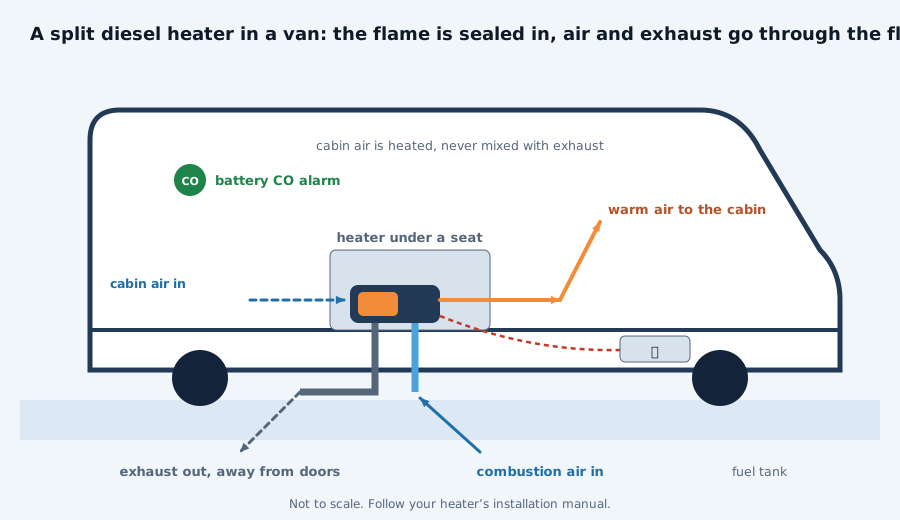
This is a split heater. The unit mounts inside the van, often under a passenger seat, while the exhaust and the combustion-air intake exit through the floor via a gasketed plate.
The kit is fuller than most. Beside the heater it holds a 12 V dosing pump, fuel hose, silencer, wiring harnesses, a stainless exhaust, an intake pipe, ducting, grilles and fixings, plus the manual.
The listing says fuel can come from the van’s tank via a standpipe, or an auxiliary tap if the vehicle maker offers one. The kit list names no standpipe or tank, so budget for one, plus a fuel filter and any extra ducting.
Ducting can run up to 15 m (49 ft) with 60 or 75 mm outlets, per the listing. That is enough to send warm air from a seat base to the back of a long van.
Owners call the instructions weak, and some received German-only paperwork. Many converters fit it themselves with our through-floor installation guide, while others pay a shop, which adds to a price already several times a budget kit.
Shipping is hazmat and the listing is non-returnable. Measure the floor and check what sits under the van before you order, not after.
Fuel and running costs overnight
Eberspächer’s published figures for the D2 class put fuel use at about 0.10 to 0.28 L/h. These are the maker’s numbers for the heater family, since the AS3 listing gives no fuel consumption.
By our arithmetic, a ten-hour night on the lowest setting burns about 1 liter, roughly a quart. Ten hours flat out burns about 2.8 L, close to three quarters of a gallon, so a small tank lasts a long weekend.
Eberspächer’s published D2 figures put the running draw at a few dozen watts at most, varying by generation. Each start and each purge draws far more for a minute or two while the glow plug heats, though the listing says the AS3 needs less start-up power than earlier models.
Altitude and cold starts
The AS3 carries an integrated altitude sensor that the listing says works up to 18,000 ft with no extra wiring. Owners report the adjustment works at ski-resort heights, where heaters tuned for sea level tend to smoke.
Thin air holds less oxygen, so a heater set for the coast runs rich in the mountains and cokes up. Our guide to running a diesel heater at altitude explains the symptoms and the manual fixes for heaters without a sensor.
The listing gives a working range down to −50 °F (−46 °C). Cold starts still depend on a healthy battery and winter-grade diesel, because summer fuel can gel in hard frost and a weak battery is the usual reason a heater fails to light.
Controls, thermostat and noise
An integrated temperature sensor and a stepless blower let the heater trim its output to hold a set temperature. The AS3 works with Eberspächer’s CAN, LIN and S+ controllers, but the kit list names none, so check which controller ships with it before you buy.
Noise is where the Espar earns much of its price. The fuel pump has a damped piston to cut the ticking and the fan is brushless, and owners describe the pump as much quieter than the budget units they replaced.
The weak point owners mention is a wide thermostat swing, where the van cools noticeably before the heater ramps back up. Many simply run it at a fixed output on the coldest nights.
Safety and the exhaust
The flame burns in a sealed chamber. Combustion air comes from outside, exhaust leaves outside, and cabin air is warmed through the heat exchanger without ever touching the flame, so a good install is safe and a bad one can kill.
Point the exhaust away from the van and its intake, clear of the sliding door and windows, somewhere snow cannot bury it. Keep fuel lines, brake lines and wiring well away from the hot exhaust pipe.
Hang a separate battery CO alarm where you sleep, and never put gasoline in the tank. To stop the heater, use the controller and wait for the cool-down purge to end before you touch the power.
What owners report
The praise is consistent. Owners describe the D2L as far better built than cheap heaters, and several say one Espar has outlasted a few budget units. The quieter pump and the altitude adjustment come up again and again.
The complaints are fewer but they matter. A few owners report fuel-pump or sensor faults after a season, and service can be hard to find in the US. The listing’s warranty runs 2 years or 2,000 hours, whichever comes first, and it rates the brushless fan for a 5,000-hour service life.
Owners also suggest an occasional spell on high to keep carbon from building up. That habit helps any diesel heater, and a premium badge does not exempt this one.
Against the VEVOR heaters, the OBAKL and other premium names
The heater we place above the Espar, for most readers, is the VEVOR all-in-one, a box that needs no drilling and sits in the cheapest band. It has to stand outside each night and states no altitude mode, which is where a fitted Espar pulls ahead.
The VEVOR 8KW split costs a fraction as much and comes with its own 10 L tank. It is rated far above what a van needs and owners report pumps that fail, so our Espar or VEVOR comparison weighs the gap for your van.
The OBAKL 2KW matches the Espar’s 2 kW size in the $$ band, but that listing is new and owner feedback is still thin. Our Espar or OBAKL page sets the two side by side.
Webasto’s Air Top heaters and the Autoterm Air 2D are the other respected names, though both have thin US listings with few owner reviews. All five picks sit on the Espar’s homepage card and in our guide to the best diesel heater for a van.
For the van you are building for good
If you sleep in your van every winter night and want a fitted heater that stays quiet for years, the D2L is the premium choice. Budget for a careful install, a fuel source and a CO alarm, and the higher price buys you peace at 2 a.m.


