Espar or VEVOR diesel heater for your van
These are the two split heaters most van builders weigh once they decide to drill the floor. The Espar is our premium install pick and the VEVOR split our budget install pick, and the right one depends on how many nights the heater runs and how long you keep the van.
Espar for the van you keep, VEVOR for the tight budget
If you live in the van through the winter and plan to keep it, the Espar Airtronic D2L is the heater to fit. If the budget is tight or the van is a weekend rig, the VEVOR 8KW split heats well for a fraction of the cost.
Both are split heaters, mounted inside with exhaust and intake under the floor, and both adjust for altitude on their own. They are our premium install pick and budget install pick in our best diesel heater for a van comparison.
Neither is our overall top pick. That is the VEVOR all-in-one, which needs no holes and sits outdoors, and the VEVOR all-in-one review covers it. This page is for the van you are ready to fit a heater into for good.
The Espar sits in the $$$ band and the VEVOR in the $ band. That gap pays for a better exchanger, a quieter pump and a warranty, and the rounds below show where each one wins.
The two heaters, spec by spec
| Espar Airtronic AS3 D2L | VEVOR 8KW Bluetooth split | |
|---|---|---|
| Type | Split kit | Split kit |
| Heat output | Up to 2 kW (6,824 BTU) on the listing; Eberspächer’s D2 figures 0.85–2.2 kW | 8 kW rated by VEVOR |
| Fuel use | About 0.10–0.28 L/h (Eberspächer’s D2 figures) | 0.16–0.62 L/h (maker) |
| Tank | None in the kit; standpipe or separate tank needed | Separate 10 L (2.6 gal) tank included |
| Power supply | 12 V, a few dozen watts at most (Eberspächer’s D2 figures) | 12 V |
| Altitude | Integrated sensor, up to 18,000 ft | Automatic, up to 18,045 ft |
| Controls | Integrated temperature sensor, stepless blower; works with CAN, LIN and S+ controllers, none named in the kit | Bluetooth app, 32 ft remote, LCD; 46–96.8 °F |
| Install needed | Through the floor; fuel source to add | Through the floor; tank in the box |
| Weight | 17.41 lb (whole kit) | 15.84 lb |
| Price band | $$$ | $ |
| Warranty | 2 years / 2,000 hours | Not stated on the listing |
Heat and van size
The Espar is a 2 kW heater, stepless down to 0.85 kW by Eberspächer’s description of the D2 family. For a well-insulated campervan the usual rule of thumb is about 2 kW, so it is sized for the job.
VEVOR rates its heater at 8 kW for 215 to 269 sq ft. Its top fuel rate of 0.62 L/h works out nearer 6 kW of fuel energy, by our arithmetic at roughly 10 kWh per liter, still about three times what most vans need.
Owners say the VEVOR heats a trailer fast. In a small van it spends most of the night turned low, which is where carbon builds.
Round goes to the Espar, for a heater sized to a van.
Install and fuel
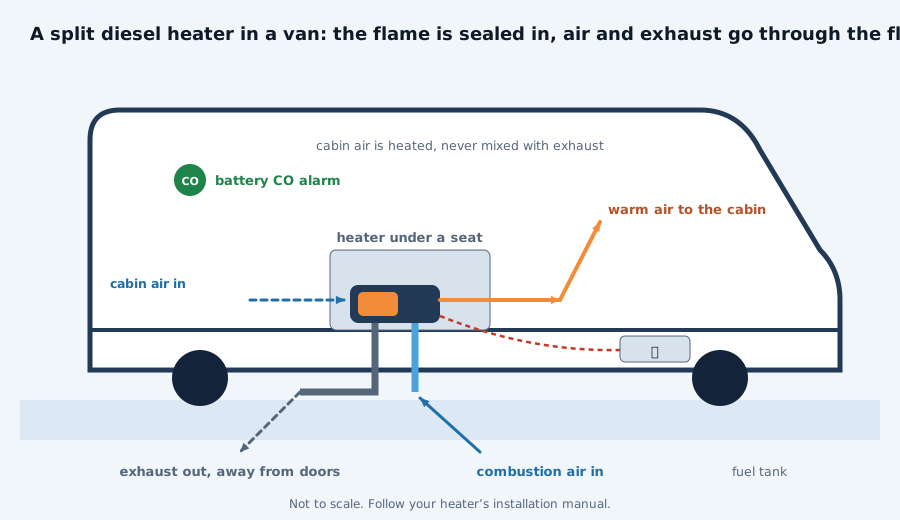
Both go through the floor, and our through-floor installation guide covers the plate, the gasket and the exhaust routing. The VEVOR brings a 10 L tank of its own, leaving the van’s fuel system untouched.
The Espar kit includes the dosing pump, exhaust, silencer, intake pipe and ducting, but no tank standpipe or fuel filter. You fit a standpipe, an auxiliary tap where the vehicle maker offers one, or a separate tank, and owners call the paperwork weak.
On fuel, Eberspächer’s published D2 figures run roughly 0.10–0.28 L/h. VEVOR quotes 0.16–0.62 L/h and about 1 gallon per night, so the VEVOR on high burns more than twice the Espar’s top rate, while also putting out more heat.
Round is a draw, an easier install for the VEVOR and lower fuel use for the Espar.
Cold and altitude
Both adjust for thin air without a manual setting. The Espar has an integrated altitude sensor good to 18,000 ft, and the VEVOR lists automatic compensation to 18,045 ft, a feature rare in the $ band.
Espar owners report the adjustment working at ski-resort heights. The Espar listing also claims operation down to −50 °F (−46 °C), while the VEVOR listing gives no low limit in what we read.
With either heater, use winter-grade diesel in hard frost and keep the battery strong. A weak supply is the commonest reason a heater refuses to start.
Round goes to the Espar, narrowly.
Noise and controls
The Espar uses a brushless fan and a damped pump piston to cut the ticking, and owners say its pump is much quieter than a budget one. That counts in a van, where the heater sits a few feet from your pillow.
The VEVOR leads on gadgets, with a Bluetooth app up to 98 ft, a remote, a timer and voice prompts. Some owners say its thermostat reads off, though Espar owners describe a wide temperature swing too.
Round goes to the Espar, because quiet beats an app at night.
Reliability and support
Espar owners say it feels far better built than cheap heaters and often outlasts several of them. A few report pump or sensor faults after a season, and US service can be hard to find, so line up an installer before you buy.
VEVOR owners describe quick warm-up and a temperature that holds steady, but the fuel pump can fail and the manual is poor. The listing states no warranty, while the Espar carries 2 years or 2,000 hours.
Round goes to the Espar.
Price and value
The VEVOR sits under $150 and the Espar above $500. That is several times the money, and plenty of owners run a VEVOR happily for a winter or two before anything needs replacing.
If the heater runs every night, the Espar’s build, warranty and quiet pump earn back much of the gap. Our guide to diesel heater brands shows where Webasto and Autoterm sit between the two.
Round goes to the VEVOR, for occasional use.
Premium fitted or budget fitted?
Fit the Espar if the van is your winter home, you often sleep at altitude, or you want a heater you can forget about. The Espar Airtronic D2L review covers it in depth.
Fit the VEVOR if you need heat now on a small budget and can live with a spare pump in the glovebox. The VEVOR 8KW review covers its install and its quirks.
Neither heater is safe with a bad install. Keep the exhaust outlet away from doors, windows and the intake and clear of snow, and keep fuel lines and wiring away from the hot pipe.
Put a standalone battery CO alarm by the bed, and let the heater finish its purge before you cut the power.
Which heater fits your van
For a van you live in all winter and will drill, the Espar D2L is the fitted heater we would choose, sized right, quiet and under warranty. If the money is not there, the VEVOR 8KW split heats a van well, as long as you fit it carefully and budget for a new pump.

