Carbon monoxide and the diesel heater in your van
A diesel heater that is fitted well keeps its exhaust outside, and that is why so many people sleep next to one every winter. Carbon monoxide gets in when the install or the heater fails, and this guide shows where that happens and how to catch it.
How a sealed heater can still leak CO
Diesel that burns cleanly leaves mostly carbon dioxide and water vapor. When the burner runs short of air or burns dirty, part of the carbon leaves as carbon monoxide (CO), a gas you cannot see or smell.
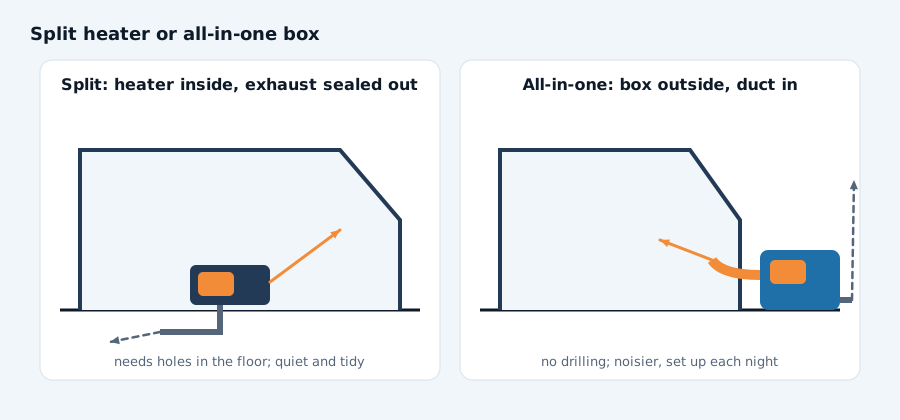
In a split heater the flame sits in a sealed chamber and the exhaust goes out under the floor. CO only reaches the cabin if that seal breaks somewhere, or if the exhaust finds its way back in from outside.
The CDC’s carbon monoxide page explains how the gas starves the body of oxygen. In a small sleeping space with the doors shut, it does not take much of it.
Where CO gets in
A loose or rusted exhaust
Every joint between the heater and the outlet is a possible leak. Clamps work loose on rough roads, and a thin budget pipe can rust or crack after a few winters.
An outlet in the wrong place
An exhaust that ends under the sliding door, by a window or close to the combustion-air intake can blow fumes straight back in. Wind, or parking with that side against a wall or a snowbank, makes it worse.
Snow and mud over the outlet
A drift or packed snow can block the outlet while you sleep. The exhaust then backs up and looks for another way out, and a worn gasket under the heater is one of them.
A cracked heat exchanger
The heat exchanger is the wall between the flame and your cabin air. If it cracks from age, overheating or a poor casting, exhaust can mix straight into the warm air blowing on you.
You cannot see that crack from outside the heater. That is why the alarm matters more than any visual check.
An all-in-one box with its exhaust inside
An all-in-one heater still burns diesel and makes exhaust. Run one in the van with the exhaust inside and you are filling a closed box with fumes.
The VEVOR all-in-one and boxes like it belong outside, with only the warm-air duct coming in. If the box has to sit inside, its exhaust must be sealed and piped out, and nobody sleeps with it running that way.
Altitude and soot make more of it
A heater set for sea level runs rich in thin mountain air, and a rich burn makes more CO and soot. Automatic altitude compensation helps, and our guide to running at altitude covers heaters that need a manual setting.
Carbon build-up does the same thing slowly. A burner choked with soot gets less air and puts more CO into the exhaust, one more reason to follow our carbon and smoke guide.
The symptoms
Carbon monoxide poisoning feels like many ordinary things, which is why people miss it. These are the common early signs.
- Headache
- Dizziness
- Nausea
- Weakness or drowsiness
- Confusion
Sleep is the dangerous part, because a sleeping person may never notice those signs. If anyone in the van feels them, switch the heater off, get out into fresh air and call 911 if someone is confused or hard to wake.
The alarm that belongs in every van
A separate battery CO alarm in the sleeping area is the one device that measures the danger itself. A good install lowers the odds, and the alarm tells you when something has gone wrong anyway.
- Choose a battery model, so it keeps working when the van battery is flat
- Mount it in the sleeping area, not right beside the warm-air outlet
- Test it often and carry spare batteries
- Check its operating temperature range, since many home alarms are built for heated rooms
- Replace it by the date printed on it
Some heaters and boxes carry a built-in CO sensor. It protects the heater’s own surroundings and is no substitute for a separate alarm by your bed.
A routine that keeps CO out
- Look at the exhaust outlet before each night and clear any snow or mud from it
- Check the exhaust clamps and pipe under the van every few weeks in winter
- Watch for smoke, soot marks or a smell of exhaust inside the van
- Run the heater on high for a while now and then so it burns clean
- Have a heater that smells of exhaust inside looked at before you sleep with it again
The full install layout is in our floor-mount installation guide, and the rest of the daily habits are in our diesel heater safety rules.
Which heater lowers the risk
No heater is safe with a bad install, and every heater here is safe enough with a good one. Still, a well-made exchanger and a stainless exhaust give you more margin over the years than a thin budget kit.
Plenty of owners run budget heaters safely for a winter or two. The difference is how much checking they ask of you, since a thin exhaust and a cheaper exchanger need a close look every season.
That margin is why the Espar is our premium choice for the safest diesel heater for a van you heat every night, though it costs several times a budget unit. Compare all five in the spec table.
Our top pick for most vans is the VEVOR all-in-one, and it is only as safe as where you put it. Set the box on the ground outdoors, or seal its exhaust and run it out through a proper pipe, and keep the CO alarm by the bed.
A diesel heater is safe when its exhaust is sealed and outside, and a CO alarm watches over you anyway. Lose either one and you are relying on luck.
For a fitted heater you sleep beside
The Espar kit comes with a stainless exhaust and a silencer, owners describe it as far better built than cheap heaters, and the listing gives a warranty of 2 years or 2,000 hours. Fit it with care and hang a battery CO alarm by the bed all the same.