A cheap diesel heater under $150, and what it gives up
Two heaters in our lineup sit in the under-$150 band, and both will warm a van. This page shows what that low price leaves out, why the 8 kW label needs a second look, and when stepping up a band pays you back over a winter.
What “cheap” means for a van heater
We never print prices, only bands. Under $150 is the $ band and $150 to $500 is $$, while anything over $500 counts as $$$.
Two of the five heaters in our best diesel heater for van comparison land in the $ band, and both come from VEVOR. One is a split kit you bolt into the van, the other an all-in-one box that stands outside.
The other three cost more for reasons you can name, from build quality to sizing. Bands also shift with sales, so check the listing before you order.
The two VEVORs in the $ band
VEVOR 8KW split, the budget install
The VEVOR 8KW Bluetooth diesel heater is a split kit with a separate 10 L (2.6 gal) tank. You mount the heater inside, run exhaust and intake through the floor, and control it from an LCD, a 32 ft remote or a phone app.
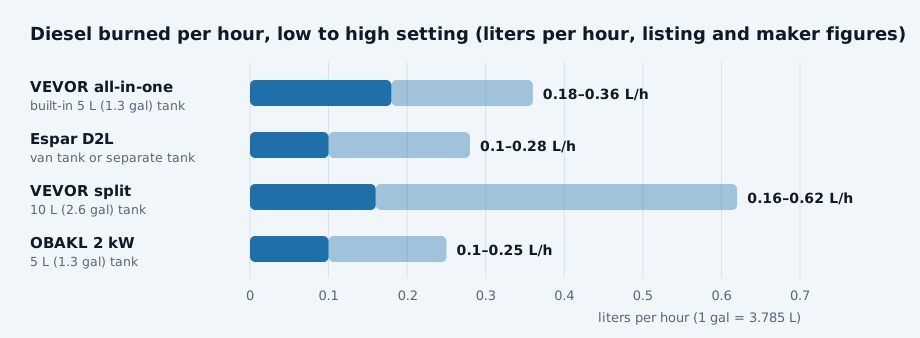
VEVOR lists 0.16 to 0.62 L/h (“about 1 gallon per night”) with automatic altitude compensation up to 18,045 ft. That altitude feature is rare at this price, and it is why the kit is our budget install pick.
The listing puts it at 15.84 lb with the tank, LCD, remote and silencer in the box. Our VEVOR 8KW review covers the install and the owner reports in full.
VEVOR 8KW All in One, the no-drill top pick
The VEVOR 8KW All in One packs heater, controls and a 5 L (1.3 gal) tank into a single case, running on 12 to 24 V. VEVOR rates it for 161 to 215 sq ft and lists 0.18 to 0.36 L/h.
A ceramic igniter helps cold starts, and the listing says it works below 9,843 ft without naming an automatic altitude mode. It is our top pick for most vans, and our VEVOR all-in-one review explains where the box earns its place and where it falls short.
What the low price gives up
Cheap heaters burn diesel the same way expensive ones do. The savings come out of parts you only notice later, usually in the middle of a cold night or after a season of use.
- The fuel pump, which owners of the VEVOR split name as the part most likely to fail
- The thermostat, which some owners say reads off, so the van runs warmer or cooler than the display claims
- The manual, which owners call poor, leaving you to piece the install together
- A believable heat figure, since an 8 kW label overstates what the fuel can deliver
- A stated warranty, which the VEVOR split listing does not give
- Smooth running, as error codes and shutdowns come up in owner reports on the all-in-one
None of this is unusual at the price. Plenty of owners run a cheap heater happily for a winter or two and treat a spare pump as part of the kit.
The 8 kW label, checked with arithmetic
Diesel holds roughly 10 kWh of energy per liter. At its top rate of 0.62 L/h, the VEVOR split takes in about 6 kW of fuel energy, so its 8 kW label is a marketing number rather than a measured output.
The all-in-one tops out at 0.36 L/h, nearer 3.6 kW of fuel energy going in, before any losses. Both sums are our arithmetic from VEVOR’s own fuel figures, and both still describe a heater that can warm a van.
Too much heater is its own problem
Most well-insulated campervans need around 2 kW by a common rule of thumb. A heater sized for much more spends most nights on its lowest setting, and long hours on low soot up the burner.
Our guide to sizing a van heater works through insulation, climate and van length. If you do buy a big budget unit, run it on high for a while regularly, as our guide to white smoke and carbon explains.
The split VEVOR at least turns down a long way. Its 0.16 L/h minimum is a gentle idle, but even that adds carbon if the burner never gets a hot run.
Split or box at this price
The split kit asks for holes in the floor and a careful afternoon or two with the manual. In return it stays in the van, runs quieter at night and keeps its exhaust under the floor where it belongs.
The all-in-one needs no drilling. You set it outside, run the warm-air duct in and pack it away when you move on, which suits a leased, rented or unconverted van and most weekend trips.
The box comes with one hard rule. It burns fuel and makes exhaust like any heater, so it stays outside, or its exhaust is sealed and piped outside, with only the warm-air duct entering the van.
Where the higher bands start paying back
| Heater | Type | Heat output | Price band |
|---|---|---|---|
| VEVOR 8KW split | Split, 10 L tank | 8 kW rated by VEVOR | $ |
| VEVOR 8KW All in One | Box, 5 L tank | 8 kW rated by VEVOR | $ |
| OBAKL 2KW | Split, 5 L tank | 2 kW | $$ |
| HCALORY TB MAX2 | Box, 7.9 L tank, also 110 V | 8 kW rated by HCALORY | $$ |
| Espar Airtronic D2L | Split kit | Up to 2 kW (Eberspächer’s D2 figures 0.85–2.2 kW) | $$$ |
The comparison table on the homepage adds fuel use, altitude and controls for all five.
The OBAKL 2KW is sized for a van rather than a cargo box, though its listing is young. The HCALORY costs more mainly because it also runs on 110 V shore power.
The Espar costs several times a budget heater. It pays that back in a better exchanger, a quieter pump, an altitude sensor and a warranty of 2 years or 2,000 hours.
Cheap traps to skip
Skip any setup that has an all-in-one inside the van with its exhaust poking out a cracked window. A gap around a pipe lets exhaust back in, and a box beside your bed is the install most likely to hurt you.
Skip cheap fuel shortcuts as well. Use winter-grade diesel in hard frost, because summer diesel can gel, and never put gasoline in a diesel heater.
Do not skimp on the battery either. A weak 12 V supply is the commonest reason a heater fails to start, and the glow plug draws far more for the first minute or two than the heater does while running.
A cheap heater is only as safe as its install. Route the exhaust outside and away from doors, windows and the intake, keep fuel lines and wiring clear of the hot pipe, and carry a separate battery CO alarm where you sleep.
Never cut the power while it runs. Switch it off and let it finish its cool-down purge, or the next start may smoke and soot.
Our pick if you want to spend the least
The VEVOR all-in-one is our top pick and the cheapest of the five, with no holes to drill and plenty of owner reviews behind it. Set it up outside each night, expect some noise and the odd error code, and keep a CO alarm by the bed.
